Encouragement for the Weary and Worn-Out Mum Heart
Mama, I see you. Eyes heavy and burning, shoulders tense, coffee barely warm because someone needed you again—and again. Whether you’re chasing toddlers, holding a newborn at 2 AM, or emotionally drained from the mental load of motherhood, I want you to know this: we are not alone, and our tired heart matters to God.
As a stay-at-home mum of three, I’ve had more “tired” days than I can count. I often joke to my husband that we are in a season of perpetual fatigue and tiredness and this is how I would sum up these years of our lives. Some days it’s physical exhaustion; other days it’s soul-deep weariness that sleep can’t fix. On those days, I’ve clung—sometimes barely—to the promises of God. And every single time, He has proven faithful.
Here are 7 promises from God’s Word that have carried me through the tired, teary, and trying moments. I pray they meet you right where you are.
1. God Will Give You Strength
“He gives strength to the weary and increases the power of the weak.” – Isaiah 40:29
You don’t have to muster up your own strength. His power is made perfect in weakness—and mama, if you’re feeling weak, you’re in the perfect position to receive His strength.
Whisper this: “Lord, I’m weary. Be my strength today.”
2. You Are Not Forgotten
“Can a mother forget the baby at her breast…? Though she may forget, I will not forget you!” – Isaiah 49:15
It’s easy to feel invisible in the daily grind—nappies, dishes, and discipline. But God sees you. He knows every sacrifice, every unseen act of love, and He calls you beloved.
Whisper this: “Even if no one sees, God sees me.”
3. His Grace Is Enough
“My grace is sufficient for you, for my power is made perfect in weakness.” – 2 Corinthians 12:9
On the days when you lose your patience or feel like you’re falling short, His grace is still enough. You don’t have to be a perfect mum—you just have to be a dependent one.
Whisper this: “I don’t have to do it all. His grace covers me.”
4. You Can Cast Every Care on Him
“Cast all your anxiety on Him because He cares for you.” – 1 Peter 5:7
That mental checklist running on loop? The worries about your child’s future? The burden you’re quietly carrying? He wants it all. Not because He needs control—but because He cares for you.
Whisper this: “God, I give you this burden. I trust You with it.”
5. His Peace Guards Your Heart
“And the peace of God, which transcends all understanding, will guard your hearts and your minds in Christ Jesus.” – Philippians 4:7
When your mind is racing and your emotions are frayed, His peace isn’t just a feeling—it’s a guard. One that stands over your heart and mind like a shield.
Whisper this: “Guard my heart today, Lord. Cover me with Your peace.”
6. He Will Finish What He Started in You
“He who began a good work in you will carry it on to completion…” – Philippians 1:6
Yes, motherhood is messy. But God is using every moment—yes, even the ones with goldfish crumbs and toddler tantrums—to shape us and our children. This is holy work.
Whisper this: “You’re not done with me, God. Keep growing me.”
7. You Are Never Alone
“And surely I am with you always, to the very end of the age.” – Matthew 28:20
When the house is finally quiet and you feel a little lost in your own skin… remember: He is with you. In the silence. In the chaos. In the midnight feedings and in the morning mess.
Whisper this: “You are with me, and that’s enough.”
Final Thoughts
Tired mama, these promises are not just pretty words—they are anchors for our soul. When our energy is low and our patience is stretched, may we hold fast to His Word. Speak it over your heart. Tape it to your fridge. Write it in lipstick on your mirror if you have to.
You don’t have to walk this road alone. Your Shepherd is walking it with you—and He will carry you when you can’t take another step.
If homeschooling has you feeling depressed or like you’re failing, please know you’re not the only one. So many parents quietly carry those feelings, even while pouring their hearts into teaching at home.
I almost had a crash recently just because of pure exhaustion and dealing with changing behaviour from one of my boys.
Homeschooling is beautiful, but it can also feel like an endless weight. We are the teacher, the parent, the organiser, the encourager — sometimes it feels like too many hats on one head. And when the day doesn’t go as planned, it’s easy to believe the lie that you’re not enough.
But here’s the truth: you are not failing. The very fact that you care this much already means you’re showing up in the most important way.
If your heart feels heavy and you are flat out exhausted, here are a few gentle reminders from my heart to yours:
Keep it simple– Learning doesn’t have to look like a perfectly structured school day. Reading stories together, cooking a meal, going on a walk, or even long conversations all count as rich learning. Our children are always absorbing.
Let go of comparison– It’s so tempting to measure ourselves against polished blogs, Instagram accounts, or even traditional schools. But homeschooling isn’t about recreating the classroom. It’s about creating a space where our children can thrive in our family’s way.
Find your people– Homeschooling can feel isolating. Most days, it’s just us and our children in all things. So whether it’s a local co-op, a Facebook group, or a few trusted friends, connecting with others who “get it” can lift so much weight off our shoulders. Sometimes just hearing “me too” makes things lighter.
Take care of you, too- It’s easy to burn out when all your energy goes into teaching. Make time — even small moments — for things that recharge you. We can’t pour from an empty cup. A quiet walk, a favourite tea, a few minutes of journaling, a warm shower, and chat to a trusted friend— can help us feel more like ourselves.
Ask for support when you need it– If your feelings of sadness or failure don’t lift, reaching out to a counselor or doctor can make a world of difference. Getting help is not weakness; it’s strength.
Low-effort homeschooling hacks
I’ve thought of a few “low-effort homeschooling hacks” — ways to give our children meaningful learning while taking pressure off ourselves when things feel heavy.
1. Audiobooks = built-in teacher. Pop on an audiobook during meals, car rides, or quiet time. Our children absorb so much just by listening — vocabulary, storytelling, history, even accents. (Bonus: you get a little break.)
2. Documentaries & educational shows count. Sometimes we feel guilty about screen time, but there’s no rule that says learning can’t happen through TV. Nature documentaries, history series, cooking shows, even YouTube channels can spark amazing conversations, learning and curiosity.
3. Turn everyday life into lessons. Cooking = maths (fractions, measurements), science (how heat changes things), and life skills. Grocery shopping = budgeting and planning. Nature walks = biology. We are always teaching way more than we realise.
4. Lean on online resources. Free platforms like Khan Academy, Crash Course Kids, or even local library apps can take the teaching role for a while. We don’t have to reinvent the wheel.
5. Interest-led “unit studies.” Instead of following a rigid schedule, pick something your child is already curious about (dinosaurs, space, baking, bugs) and weave lessons around it. Read a book, watch a video, do a craft — done! Children learn best when they’re interested.
6. Outsource where you can. Co-ops, community classes, or even a trusted family member teaching a skill can give you breathing room. You don’t have to be the expert in every subject.
7. Embrace “slow days.” Not every day has to be full of worksheets and structured lessons. Sometimes a day of reading, drawing, building Legos, or just talking counts just as much as the busy days.
On the really heavy and exhausting days, I remind myself that the secret to homeschooling is that it doesn’t have to look like school at home. The most powerful thing our children gain is the time, attention, and love that I am giving them.
Nurturing my boys’ hearts is one of the most important parts of my role as their mother. As a homeschooling mum of three boys, my husband and I have the privilege of being with them daily, shaping their character and guiding them toward Christ and into being strong boys and eventually men.
Homeschooling gives us a beautiful window of time and influence to not only teach academics, but to shepherd the hearts of our sons with intention. I always remind myself that It’s not just about teaching maths and reading—it’s about helping them develop a heart that seeks after God, is resilient, loves others well, and stands firm in the Christian faith. In a world that will constantly try to define them by achievements and success, I want them to know that their true worth is found in being sons of the true King.
Seeing their hearts
When we started our homeschool journey I was so geared toward only building them up academically, but I very quickly realised that in order to build a meaningful learning experience for them, I would need to win their hearts over with love, friendship and trust. Building a relationship with each boy where I do my best to see them for their individual strengths and personalities would help strengthen their sense of safety and confidence. It isn’t easy, because most of our days are quite loud and feel chaotic, and so the last thing I want to do is notice and compliment all the great and fun things about them (just being honest!) It’s a discipline that I am working on being more intentional in.
It’s also really easy to focus on correcting behaviour all the time, but true growth happens when we understand the heart behind it. When a boy is acting out or withdrawing, it’s often a signal of something deeper—confusion, frustration, or even a need for connection. Being intentional in this area for me means, trying my best to remember to pause, ask questions, and listen with grace.
“A gentle answer turns away wrath, but a harsh word stirs up anger.” – Proverbs 15:1
Grace-based correction—rooted in relationship—helps a boy know that he’s loved, even when he makes mistakes.
Encouraging emotional honesty and empathy
Many boys are naturally active, physical learners, but they also carry deep emotions—sometimes masked by noise or movement. We’ve had to learn to give our sons language for their feelings. This helps them to communicate in a more self controlled way when they are feeling an emotion.
Creating an atmosphere of love and grace at home is also essential. I want my boys to know that our home is a safe place where they can be vulnerable, share their fears, and ask hard questions. I remind them that no mistake is too big for God’s grace and that nothing they do can separate them from His love—or mine. By showing them unconditional love, I hope to give them a glimpse of the immeasurable love of their Heavenly Father.
Conversations
Intentional conversations are another way I nurture their hearts. Whether it’s around the dinner table, during a car ride, or at bedtime, I try to engage their minds and hearts with meaningful discussions. We talk about faith, courage, kindness, and even the struggles they face, or anything random that may come to mind. I want them to know that their thoughts and feelings matter, and more importantly, that God cares about every detail of their lives.
Life skills
In raising boys, we’re not just preparing them for independence—we’re shaping their character and hearts for the life God is calling them to live. Teaching life skills within the rhythm of home and homeschool life is a sacred opportunity: a chance to model servant leadership, responsibility, and integrity. The boys are involved with learning to cook, tidying the garden and house, caring for each other and discussing life matters. As we teach our sons to work with their hands and think with wisdom, our desire and prayer is that it will help them grow into men who are not only capable but compassionate—anchored in faith, and willing to serve and work hard.
Service
Encouraging them to serve others is another way to shape their hearts for Christ. I remind them that true strength is found in humility and that leadership comes through service. Whether it’s helping a younger sibling, assisting a friend, or participating at church, I want them to experience the joy that comes from putting others before themselves. Jesus was the ultimate servant, and I pray my boys will follow in His footsteps.
Above all, I entrust their hearts to the Lord. I can do my best to teach, guide, and love them, but ultimately, their walk with God is their own. My prayer is that they will grow into men who love Jesus deeply, stand firm in truth, and live with integrity. Proverbs 3:5-6 says, “Trust in the Lord with all your heart and lean not on your own understanding; in all your ways submit to him, and he will make your paths straight.” That is my hope and prayer for my boys—that as they journey through life, their hearts will grow to be steadfast in Christ.
If you’re anything like me, juggling the homeschooling of three energetic boys and in general young children can sometimes be so overwhelming. Between the teaching, snack breaks, constant tidying up of little people and cooking, it can feel like the day is running us instead of the other way around. But fear not! I’m here to share some tips on how to build a home schedule that actually works—at least most of the time.
Be flexible
First things first, let’s talk about flexibility. As much as I love the idea of a perfectly structured day, with every minute accounted for, I’ve learned that life with kids, especially boys, just doesn’t work that way. There’s always going to be something that throws a wrench into our plans, whether it’s spilled food, an unexpected discovery of a “treasure” in the garden, or a tired and unmotivated gloom of the day. So, while it’s important to have a schedule, it’s equally important to hold it loosely. I like to think of our schedule now as more of a guideline than a strict timetable.
Create blocks of time
One thing that has been a game-changer for us is creating blocks of time instead of specific time slots. For example, we have a morning block for our core subjects like devotion, maths, reading, penmanship etc, an afternoon block for creative activities, and an evening block for family time. This way, if we spend a little extra time on a science experiment (or cleaning up from said experiment), it doesn’t throw the whole day off. It gives us the flexibility to dive deeper into subjects that capture the boys’ interest without feeling rushed.
Another tip is to incorporate plenty of breaks. Boys, in particular, seem to have an endless supply of energy, and expecting them to sit still for hours on end is a recipe for disaster (I’ve tried and learnt my lesson)! We do short bursts of focused learning followed by movement breaks. This may mean a quick game of hide and seek, a workout break, a few minutes on the trampoline, or even a spontaneous dance party in the living room with a Youtube video. These breaks help them burn off energy and come back to their work refreshed and ready to concentrate. I’ll always communicate to them and let them know what’s coming next in the day. This helps to prevent tantrums and resistance when it’s time to move on to the next activity.
Time for ourselves
It’s also crucial to build in some time for ourselves – even though most of the time it feels absolutely impossible! This season simply doesn’t permit me to have my free time as I would like all the time so I am learning that it is possible to infuse things that I enjoy throughout my day. Considering this as self care really helps me to know that I am not counting myself out of the family schedule and planning.
Whether it’s a quiet cup of tea before the boys wake up, a quick workout, some time spent in prayer and reflection, spraying a little perfume, a 5 minute make up routine, or putting on smart clothes for the day, taking care of ourselves even in the littlest way helps us to take better care of our families Remember, you can’t pour from an empty cup. So, carve out those moments of rest and rejuvenation whenever you can.
Use tools to stay on track
Using tools to stay on track can be incredibly helpful in maintaining a sense of order in the home. I have found that keeping a family calendar on the fridge helps everyone stay informed about daily plans and responsibilities. Additionally, a simple to-do list or planner can bring structure to the day and prevent tasks from feeling overwhelming. Personally, I enjoy using a prayer journal alongside my schedule—it not only keeps me organized but also allows me to reflect on God’s presence in my day-to-day life. Whether it’s a digital app or a traditional planner, having a system in place makes a big difference in staying consistent and finding peace amidst the busy routine.
Reassess and adjust regularly
Reassessing and adjusting regularly is crucial to maintaining a healthy and sustainable home schedule. It’s one of the things that I really struggled with initially, but the reality is that life is constantly changing—children grow, schedules shift, and unexpected circumstances arise. Taking time each month or even each week to evaluate what’s working and what’s causing stress can make a big difference. I like to pray over my schedule, asking God for wisdom to discern what needs to be adjusted. If a routine is feeling burdensome, it might be time to simplify or delegate tasks. Being flexible allows for grace in our daily lives, ensuring that our schedule serves us rather than us becoming slaves to it. Adjustments are not signs of failure but of growth and intentionality in creating a home filled with peace and joy.
So there you are! A few tips which I hope you’ll find helpful and encouraging. Building a home schedule that works is all about finding what fits your family’s rhythm and being willing to adjust as needed. With a little planning, a lot of flexibility, and a healthy dose of humor, you can create a routine that keeps everyone learning, laughing, and loving the homeschooling and home life. Keep up the great work, mama! You’ve got this.
Raising confident and resilient boys in today’s world is challenging, unpredictable, full of constant adjustments, chaotic, downright exhausting, deeply fulfilling, messy and full of lots of teaching moments. As a homeschooling mum to three boys who are still babies to me (6,4 and 2 years) I am slowly learning that raising strong, capable young boys into men has become one of our aims. This isn’t about giving them an ego boost or bubble-wrapping them from failure, but about teaching them how to handle themselves when life’s inevitable bumps occur, and to deal with imperfections and bruises with grace, grit, and from a strong foundation in Christ.
Perseverance
One of the first and constant lessons that we are currently working on, is that failure and imperfection isn’t the enemy. When they get answers wrong, make a mistake or do something imperfectly, their natural response is to shut down, give up or walk away in tears because of the feelings of frustration and disappointment. In our home, my husband and I are consistent in pushing back against this and communicating to them that we celebrate mistakes (sometimes with a little treat) because they are an opportunity for us to learn and grow stronger.
When my first born son struggles with a concept during our learning time, or he colours out of the line during art time, we respond with enthusiasm because we have a chance to try again, and sometimes that is what life gives us- a chance to try again. We encourage him to know that it is ok to feel what he is feeling, but that he should never quit on himself. Resilience isn’t about never falling down; it’s about getting back up, dusting off the sawdust, and trusting that God will guide and strengthen us as we try again.
Confidence, too, is something that we are nurturing. As our boys are very young, we offer this through constant praise the majority of the time because I recognise that our hearts need to know that we are seen by those closest to us, and as their mama, it is my joy to let them know that I see them, love them, celebrate and affirm them.
There are moments when we explain that as they grow, their confidence wont come from constant praise but from real accomplishments and faith in God’s plan. So we do occasionally let them struggle and push through math problems, writing that tricky word for what feels like the hundredth time, and learning how to work together to serve one another during meal times (putting cutlery out, and setting the table). When they achieve something after working for it, the confidence sticks because they know they earned it through perseverance and God’s strength.
Service unto each other and strangers
My boys are very visual, and I quickly learnt that in order to capture their attention and imagination, it would be very helpful to give them a vision of the kind of boy and man that God is helping them to become day by day.
We usually say something along the lines of:
“God has created you for a purpose, and no challenge is too big when you walk in His strength. Keep trusting Him, keep learning, and keep growing into the man He is shaping you to be.“
“You are a warrior for Christ, and true strength comes from faith, kindness, and perseverance. No matter what happens, remember that God is always with you, guiding your steps.”
“When you do hard things, God is helping you grow stronger and stronger”.
We are all naturally self centered, and children demonstrate that to the highest degree because they are children(!), have constant legitimate needs and are under developed in their understanding, maturity and expression of their needs.
Another one of the areas that I am working on when it comes to raising resilient sons is teaching them to serve each other and other people. Serving each other doesn’t always feel pleasant because they bicker, fight and compete against one another, but by learning the discipline of service to one another, they fulfill a really important goal of our family which is to love and work together as one in our home.
When they understand that their strength, and their faculties (hands, feet, eyes, speech) are meant to be used for God’s glory it gives them an external motivation. So gentle reminders are given when we are at home and out in public to help them think outside of themselves and to see the world and people around them—whether that means helping to open the door for someone or comforting a friend who’s has been hurt— it’s all to help them develop a deep, quiet confidence that isn’t rooted in arrogance, but in purpose. Plus, let’s be honest, there’s nothing quite as humbling as helping to clean up after your brother or others! Jesus Himself taught us that true leadership comes through service, and I want my boys to follow His example, and understand the inner strength it takes to think of others.
It’s OK to cry
We are at a stage in life with our boys where crying is the resounding sound in our home, so let’s talk about emotions for a second. We are balancing the importance of them talking with us when they are upset over screaming and shouting. Simultaneously we acknowledge that being strong doesn’t mean stuffing down their feelings and pretending that they are ok when they aren’t.
Boys also need space to express frustration, sadness, and even joy without being told to “be strong.” In our home, we encourage each other to talk things through—sometimes by removing them from a tense environment because resilience isn’t about hiding emotions but trying our best to handle them in a Christ-centered way. Praying together, reading God’s Word, and seeking His wisdom helps us all to process our emotions in a way that strengthens our faith and character.
Role Models
Positive role models also play a crucial role in building resilience. Boys need to see strong, faith-filled men who exemplify integrity, perseverance, and humility. Whether it’s their father, a pastor, a coach, or a trusted mentor, having godly role models shows them what it means to live with strength and grace under pressure. When they see men who turn to God in times of struggle, who admit their mistakes, and who stand firm in their beliefs, they learn to do the same. Surrounding them with wise, godly counsel reinforces the values we teach at home and gives them examples to emulate as they grow. As they are young, we have begun that journey for them through stories and books, as well as spending quality time with daddy.
Proverbs 22:6 reminds us to “train up a child in the way he should go, and when he is old, he will not depart from it.” At the end of the day, our goal isn’t to raise tough guys; it’s to raise kind, courageous, and faithful men who will stand firm in a shaky world. With a lot of prayer, patience, and probably a lot more mistakes, I trust that God will shape them into exactly who He created them to be, and we look forward to celebrating the good fruit that comes from their lives!
I don’t know about you, but there are some days when I look around at the chaos of our homeschool and wonder, What in the world is going on? The boys are arguing, fighting and screaming over toys, I am getting resistance with sit down book work and reading, and my youngest is determined to turn all the walls of my house into his museum of drawings. Meanwhile, I’m nursing a cold cup of coffee, a very messy kitchen (even though it was cleaned the night before), and sleepiness from waking up at 4:45am just to get a head start on the day before everyone wakes up. With fatigue, strain, frustration and overwhelm at an all time high, its easy to question whether we made the right decision to homeschool.
Some days, these are my thoughts, so first of all, I want to assure you that if you have felt any of this, you are not alone. There is no homeschooling mum on this planet (or probably even in the universe, if alien homeschooling mums exist) who hasn’t wondered at least once if she made a monumental mistake. It’s normal. We’ve all had those moments of doubt—when the curriculum doesn’t click, when the kids resist every lesson, or when we constantly feel that we are not enough. But let me remind you of something that God has been whispering to my heart lately: His grace is sufficient. Even on the hard days. Especially on the hard days. Here’s a beautiful hymn for you to tuck away in your heart.
I get it, though. It’s easy to romanticise homeschooling before we start. We picture morning devotionals with well-behaved children, afternoons spent exploring nature, and evenings reading classic literature in a cosy setting. Reality looks a little more like Weetabix smeared on every surface, (AND THEN DRYING IN A BLINK OF AN EYE!!), disruptive food requests every. five. minutes, and a “read-aloud” where you’re the only one actually listening to the story. And yet, even in the mess, there are so many beautiful moments waiting to be noticed.
A few tips and encouragement
When doubt comes knocking, I’ve found it helps to revisit why my husband and I chose this path in the first place. For me, it’s about nurturing my boys’ hearts as much as their minds. It’s about weaving our faith into their education and having the freedom to teach them in a way that honours their unique gifts and strengths. Yes, even when those gifts include making fart noises during lessons. (Lord, give me strength with these boys.)
Sometimes we just need to change our perspective. If a lesson is flopping or the kids are bouncing off the walls, maybe it’s time to pause the plan for the day. Go outside for a walk (which is my absolute go to), build a blanket fort, or get in the kitchen and bake and call it “life skills.” It all still counts. I have learnt that homeschooling isn’t about sticking rigidly to a schedule; it’s about creating a life where learning happens naturally and joyfully—well, most of the time for the children, and for us as mums.
Another thing that helps is connecting with other homeschooling mums. Join a co-op, find a support group, or just call that one friend who always “gets it.” There’s something so comforting about hearing someone else say, “Oh, me too!” We were made for community, and sharing our struggles often lightens the load.
Grace is available
Don’t forget to extend yourself some grace. God didn’t call us to this journey because He thought we would do it perfectly. He called us and wants us to depend upon Him every step of the way. Your children don’t need a perfect teacher; they need you. They need your love, your laughter, and yes, even your occasional meltdowns. (I firmly believe that seeing us apologise, pray for strength, handle difficult moments and regroup is an important life lesson for them.)
So, on the days when you’re tempted to throw in the towel, remember this: You are planting seeds, even when you can’t see the harvest yet. The hard days are part of the story, but they’re not the whole story. And who knows? Maybe one day, your children will look back on these years and thank you for the gift of learning together. They’ll remember a specific day (that you thought was pretty awful) and say that was one of the best moments of their lives. Or at least in my case they’ll remember how to bake really good cakes. Either way, you’re doing just fine, Mama. Keep going. ❤️
As a homeschooling mum to three energetic boys, I’ve had my fair share of days where the kitchen resembles a science lab, and our garden a war zone as they play together and learn! Keeping my boys engaged in their studies is not always the easiest, especially when all they want to do is climb trees and launch themselves off of anything furniture-like. With a sprinkle of creativity, and a lot of patience and prayer, I’ve discovered some fantastic ways to turn their boundless energy into fruitful learning adventures. In this post, I’ll be sharing some fun and creative homeschooling ideas that have helped me, and hopefully will help keep your boys not just busy, but excited about learning!
Just to let you know that this post contains affiliate links. I’ll only recommend items that we use or would use. If you make a purchase through these links, I may earn a small commission at no extra cost to you. Your support helps keep this blog running. Thank you!
1. Add plenty of breaks during sit down learning time (for those that need it).
Taking regular breaks is a game-changer when it comes to helping boys focus on their learning. Boys, with high energy levels and a natural inclination towards physical activity, often find it challenging to sit still and concentrate for long periods. My eldest really finds it challenging to be still for so long and so regular breaks allows him to burn off some of that excess energy, which then significantly improves his ability to focus. We use a timer to create a rhythm to our day: 20-30 minutes of focused work followed by a short break. During these breaks, the boys can run around outside, have a snack, or play with their toys. This helps them to have a little bit of a mental reset so they feel refreshed and ready to continue concentrating.
Adding regular breaks into our homeschooling routine felt counterintuitive at first—my brain was thinking “aren’t we supposed to be maximising learning time?” But trust me, these breaks are not just about pausing work; they’re about enhancing the overall quality of learning, and embracing the natural wiggles and jumps of my boys as part of a balanced and effective homeschooling strategy!
2. Include creative and interesting field trips for boys.
Incorporating real-world experiences into learning is another way to keep boys engaged. Field trips to museums, farms, factories, and historical sites bring lessons to life. Even a simple outing to the local park can become educational with a bit of planning. Nature walks can turn into biology lessons, and trips to the supermarket can involve maths and economics. Boys learn best when they can see, touch, and experience the world around them.
Honestly, field trips are a real gem, and provide so much. They may take a little bit of planning, and can feel tiresome for us mums, but for my boys they break up the monotony of sitting at a desk everyday, and provide a change of scenery that can re-energise and motivate them. The anticipation of a fun and interesting trip can keep them engaged and give them something to look forward to. Also, field trips often involve interacting with other people, whether it’s a tour guide, other students, or community members. These interactions help my boys practice and develop important social skills such as listening, asking questions, and working collaboratively. They also provide opportunities to practice good manners and respectful behaviour in different settings.
What I love most about field trips is that they can light the flame for curiosity and exploration. Children are naturally curious and love to explore and trips cater to this curiosity and encourage them to ask questions, seek out new information, and explore their interests. This sense of adventure can ignite a lifelong love of learning and discovery!
3. Boys need arts, crafts and DIY too
Encouraging creativity through arts, crafts and DIY builds can also be highly engaging for boys. They may be enthusiastic about drawing or painting, and often love projects that involve building, sculpting, or assembling. This is because generally, boys excel when it comes to kinesthetic learning, which involves doing and creating. Building projects and crafts provide a tactile, hands-on way to grasp concepts that might seem abstract or challenging when presented through traditional methods. This type of learning can make subjects like maths, science, and engineering more relatable and understandable.
We’ve made everything from cardboard castles to clay models of the solar system, our own electronic fans (that work!) and so much more. These activities have not only provided a welcome break from more structured academic work, but they have allowed my boys to express themselves, and develop fine motor skills. I love including DIY build projects in our week because they often require time and attention to detail which helps develop patience and focus. Whether they’re meticulously assembling a model or carefully following instructions for a craft, these activities teach them to concentrate and see a task through to the end. Successfully completing a project or creating something from scratch also significantly boosts their confidence and sense of accomplishment.
4. Create healthy competitive group games.
One afternoon I sat looking outside my kitchen window at my 3 boys and their boy cousin as couldn’t help but smile as they played very physical competitive games with each other in the garden. It was a very sweet moment and made me realise that socialisation is another critical aspect of homeschooling, and boys often thrive in group settings where they can collaborate and compete in a healthy way. We regularly meet up with other homeschooling families for group activities. Whether it’s a science club or geography club, a sports team, or a co-op where we parents take turns teaching, these interactions provide invaluable opportunities for boys to learn social skills and build friendships.
When structured well, competitive games can teach boys about healthy competition. They learn to strive for their best while maintaining respect for their opponents, and I believe that this balance helps them develop a positive attitude towards competition, emphasising effort and improvement over just winning. Above all, competitive games are fun! They provide a break from routine and offer a joyful and exciting way to learn and grow.
5. Technology & boys.
Incorporating technology thoughtfully and at the right age can be a game-changer in keeping boys interested in learning. If your boy is anything like mine, they are probably easily drawn to gadgets and screens, so we occasionally use educational apps and websites to supplement some of our lessons. There are fantastic resources out there for everything from coding to virtual museum tours. We also use educational games and interactive software to make learning more dynamic. However, it’s important to balance screen time with physical activities and face-to-face interactions.
Homeschooling boys is an amazing blend of chaos and joy. I am finding my feet and balance with embracing their boundless energy, and turning everyday moments into fun learning opportunities. I hope some of these tips will help you survive amidst the noise and mess, and remember that within it all, you’re creating a rich, dynamic learning environment and precious memories that will last a lifetime.
As a homeschooling mum of three very energetic boys, my days are filled with the kind of energy that could power a small town! If you’re thinking about homeschooling your boys, or if you’re already in the experience of it, let me tell you—it’s a wild, wonderful ride. Boys have a unique way of turning even the most mundane tasks into grand adventures. Whether it’s transforming the living room into a battlefield or discovering the science of “how high can we launch this toy?”—there’s never a dull moment. And while it can be exhausting, it’s also incredibly rewarding.
One of the first things I learned about homeschooling boys is the importance of movement. They are not designed to sit still for long periods, and that’s perfectly okay. We embrace a lot of breaks, outdoor play, and hands-on learning e.g. maths becomes more engaging when you use Legos or Magna Tiles to solve them and spelling words are more fun when you can jump on a trampoline while reciting them, or use spelling games. The garden and nearby parks often serves as our classroom, where nature walks turn into impromptu science lessons. And let’s not forget the endless supply of sticks that magically transform into swords, wands, or digging tools for their “archaeological” digs and builds.
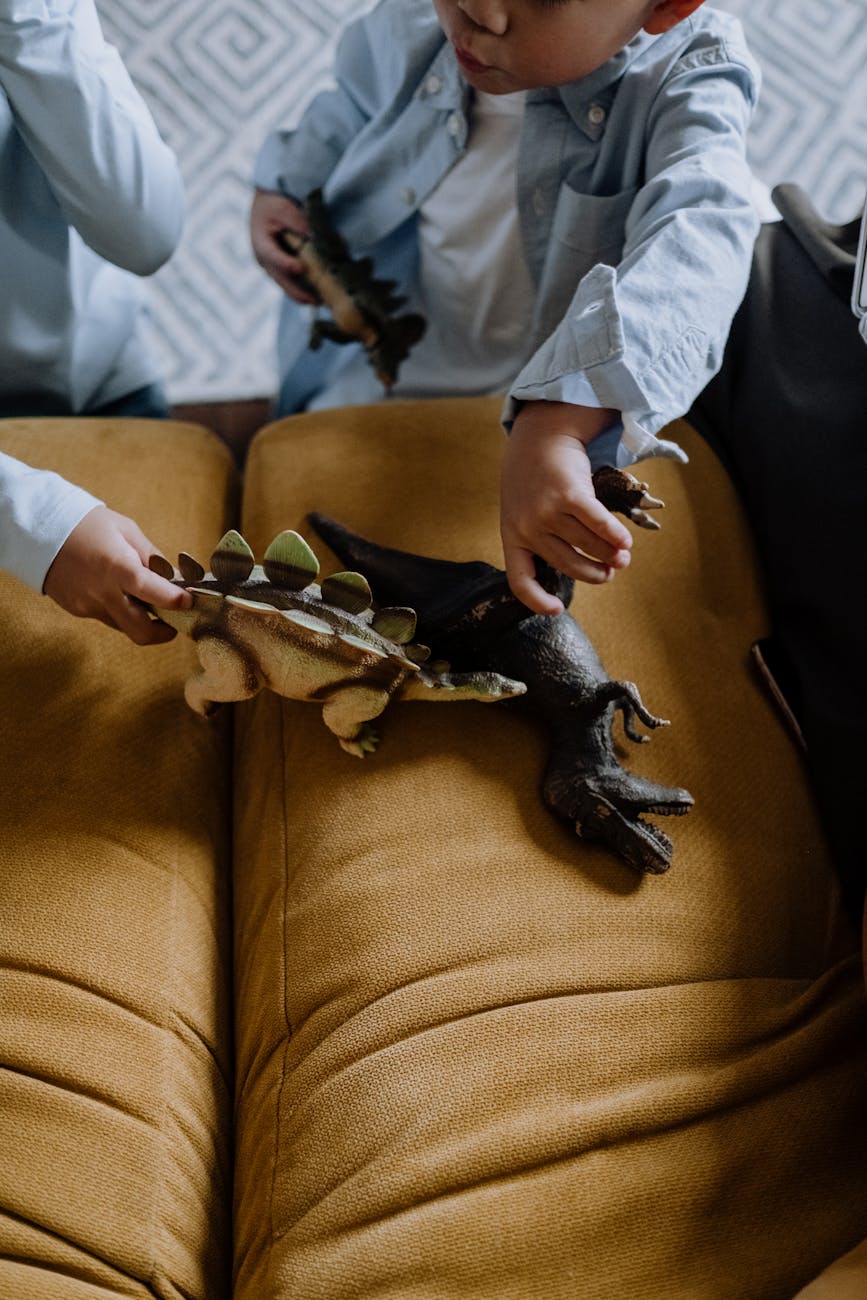
Another key element is embracing their interests. My boys are fascinated by everything from dinosaurs to superheroes, so I weave these themes into our lessons. Stories come alive when we read about warriors and kings and characters they love. By tapping into what excites them, I find they’re more engaged and eager to learn. And let’s be honest, when they’re excited, it makes my job much easier—and a lot more fun!
Of course, there are challenging days, like when our science experiment explodes all over the kitchen (note to self: always double-check the measurements), or I am contending with bad attitudes and tantrums. But even in those moments, there are valuable lessons to be learned—like the importance of perseverance, patience, and sometimes, the necessity of a good sense of humour. After all, laughter can turn a disaster into a memorable teaching moment. Homeschooling boys is a journey of discovery, for both them and us as parents. It’s about finding the balance between structure and spontaneity, discipline and freedom. And in the midst of the noise and chaos, it’s about cherishing the opportunity to shape and nurture their curious minds and adventurous spirits.
Another essential part of homeschooling boys is fostering their sense of independence and responsibility. Boys often thrive when given the chance to take the lead and solve problems on their own. I’ve found that incorporating practical life skills into our daily routine not only keeps them engaged but also helps them feel capable and accomplished. Whether it’s cooking a simple meal, managing their own chore charts, or building something with their hands, these activities teach them invaluable lessons about self-reliance and accountability. Plus, it’s amazing to see the pride in their eyes when they successfully complete a task or project!
Lastly, let’s talk about the importance of cultivating a sense of faith and character. As a Christian homeschooling mum, I see each day as an opportunity to instill values like kindness, integrity, and compassion. Our Bible devotion time isn’t just another subject on the schedule; it’s a cornerstone of our day. Through stories, prayers, and discussions, we are intentionally seeking to shape and guide our boys in understanding and living out their faith.
We talk about real-life applications, like showing kindness to a sibling or being honest even when it’s hard. These moments are the heart of our homeschooling journey, helping shape them not just into knowledgeable individuals, but also men of strong character and faith. So, as we navigate the ups and downs of homeschooling, I’m constantly reminded that this journey is about much more than academics—it’s about raising my boys to be thoughtful, faithful, and compassionate individuals ready to make a positive impact on the world.
Amidst all the (chaotic) lessons and life skills, I am really trying to not forget the importance of simply having fun together. Building forts out of blankets, going on impromptu scavenger hunts, and having dance battles in the living room are just as crucial as any maths or reading lesson. These joyful, spontaneous moments create bonds and memories that will last a lifetime. They remind us why we chose this path in the first place—to enjoy the freedom to learn and grow together as a family. Homeschooling is as much about nurturing our relationships and creating a loving, supportive environment as it is about education.
So, here’s to all the homeschooling mums of boys out there—may your coffee be strong, your patience be long, and your days filled with love and laughter.
Thank you for joining me on this journey of motherhood and faith. If you found comfort and encouragement in this post, I invite you to explore more of my writings on similar topics.
On my blog, you’ll discover a wealth of stories, tips, and reflections aimed at nurturing your spirit and supporting you through the beautiful chaos of motherhood.
From practical advice on balancing daily responsibilities to heartfelt reflections on deepening your relationship with God, there’s something for every season of motherhood. I’ve shared real-life experiences, lessons learned, and moments of grace that I hope will resonate with you and provide the encouragement you need.
Visit my blog for more posts on creating a peaceful home, finding joy in the little moments, and leaning into God’s strength amidst the challenges. Let’s continue this journey together, growing in faith and love, one step at a time.
Disclosure: This post contains affiliate links, which means I make a small commission at no extra cost to you. See my full disclosure here.
Homeschooling our boys has so far been such an exciting and full on journey! We are delving head on into wonder-filled discovery and it has been both my challenge and joy to help the boys lean more into their learning styles, as well as value and enjoy the process of learning! Hands up if you are the type of mum that picks up every educational book because you just KNOW that it’ll add value to their learning experience? Or was it at a price that you couldn’t resist? ha!
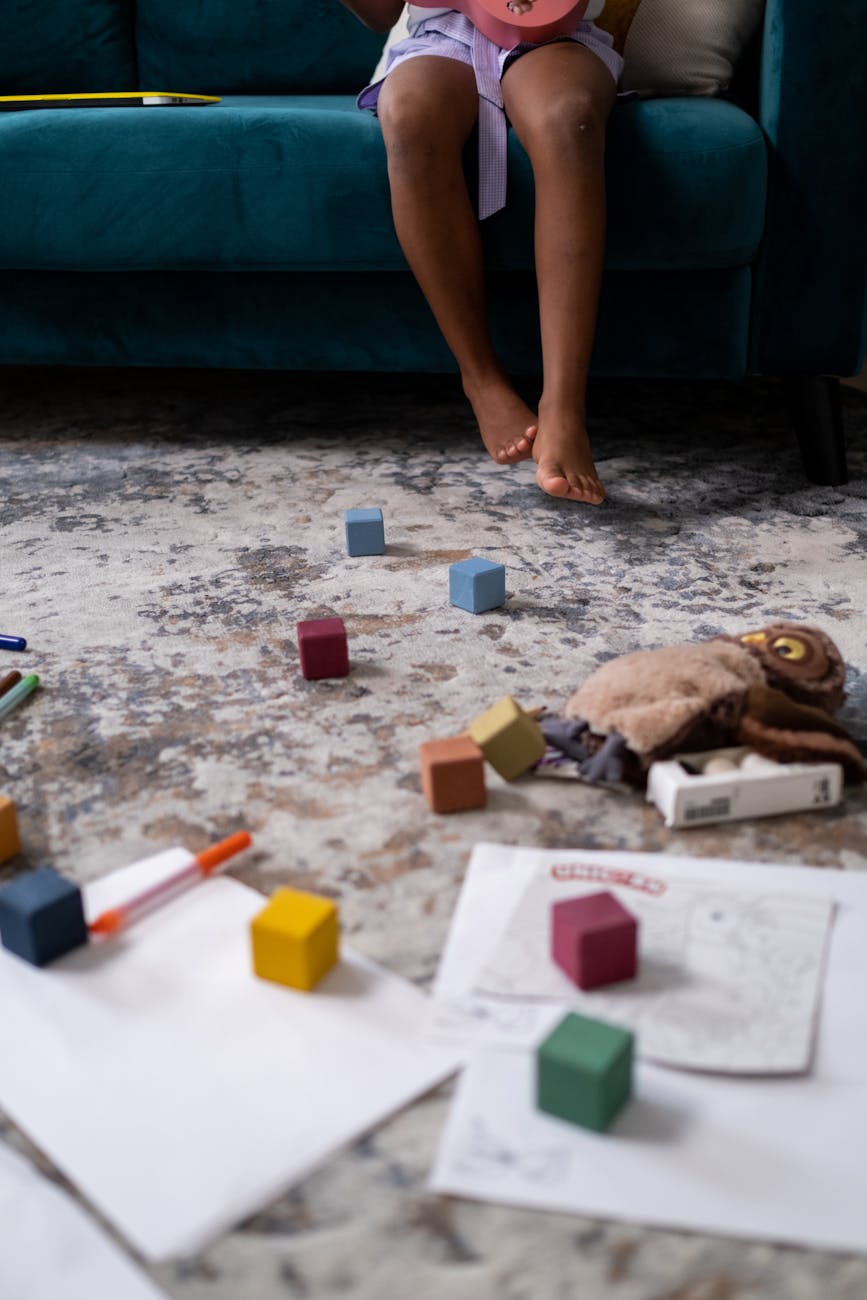
One of the challenges with Home Ed is keeping all your things organised! Managing books, supplies, toys and resources can quickly become overwhelming if not handled with care. An organised homeschool space is crucial for maintaining a productive and stress-free learning atmosphere – no matter the size of your space. Here are some practical tips to help you create an organised and efficient homeschool environment.
1. Create a dedicated homeschool space
One of the beauties of homeschooling is that we can create a beautiful seamless flow between home life and learning. I think even with this though, when it comes to some sit down learning, it’s useful to designate a specific area in your home for homeschooling. This space doesn’t need to be a separate room; a corner of a living room, dining table, or dining area can work just fine. The key is to have a consistent place where all specific learning activities take place and where all materials are stored.
A designated learning space helps to minimise distractions that are common in other parts of the house. It provides a controlled environment where toys, TV, and other household activities are not within immediate reach, encouraging and training our children’s minds to concentrate. Also, if you have multiple children who do not learn together, you can create separate play/learning areas so each child can focus on what they are doing.
Also, for us mamas, it helps us to feel organised and in control of the homeschooling process. This designated area allows for all educational materials, books, and supplies to be kept in one place, reducing clutter and the stress of searching for items when needed. It also establishes a clear routine and structure within our home, making it easier for us to manage daily schedules and transitions between activities. Knowing that there is a specific, orderly spot for learning activities not only streamlines the homeschooling process but also creates a sense of calm and efficiency (I play instrumentals on the speaker when my eldest is learning at the table).
2. Use bookshelves wisely
Books are an essential part of homeschooling! They transport us to the world, and fill our hearts and minds with such wonder. I am a big fan of books and I am working so intentionally to make it part of the children’s lives. When we started homeschooling, one of the first things I was told was “all you need is a Bible and a library card”. Books at home can quickly accumulate though without you realising it! Invest in sturdy bookshelves to keep them organised. Here are some ways that we have used bookshelves and been creative with them!
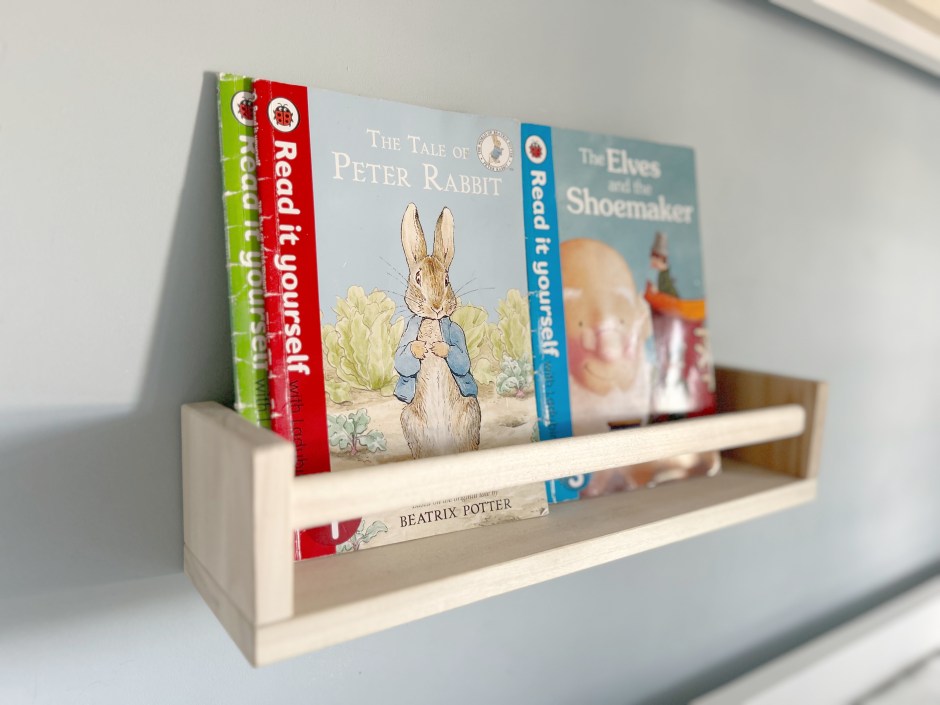
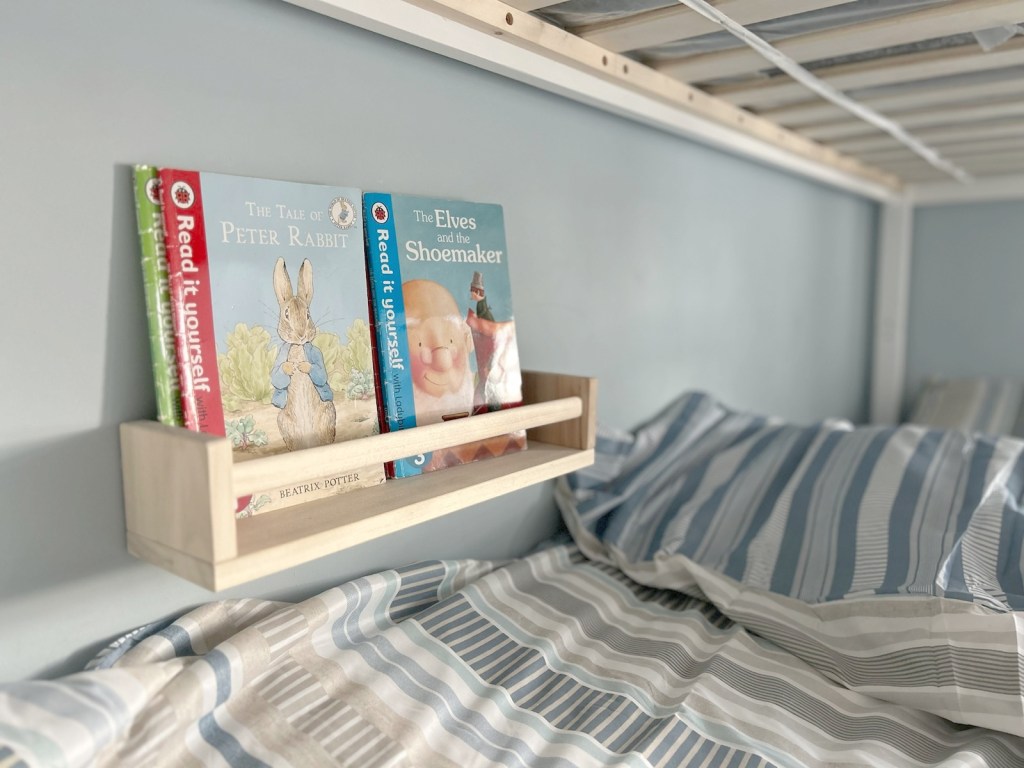
Floating mounted book shelves by each boys sleeping area has been a great addition to the boys room. I wanted to create a private and personal area for them to keep their most favourite books that they could read in bed either in the morning if they wake up early or the evening before they go to sleep.
An accessible book case is also great for encouraging independent reading and access to books. By having a dedicated space at their height, children can independently explore and choose books that pique their interest and this creates a sense of ownership and excitement about reading. Even my 2 year old enjoys taking books from the shelf!
Book binsare also utilised for taller books, and to make it more fun for the children, we have them placed in different locations of the house. These bins are regularly rotated to keep the interest, as they don’t know what treasures they’ll find in them!
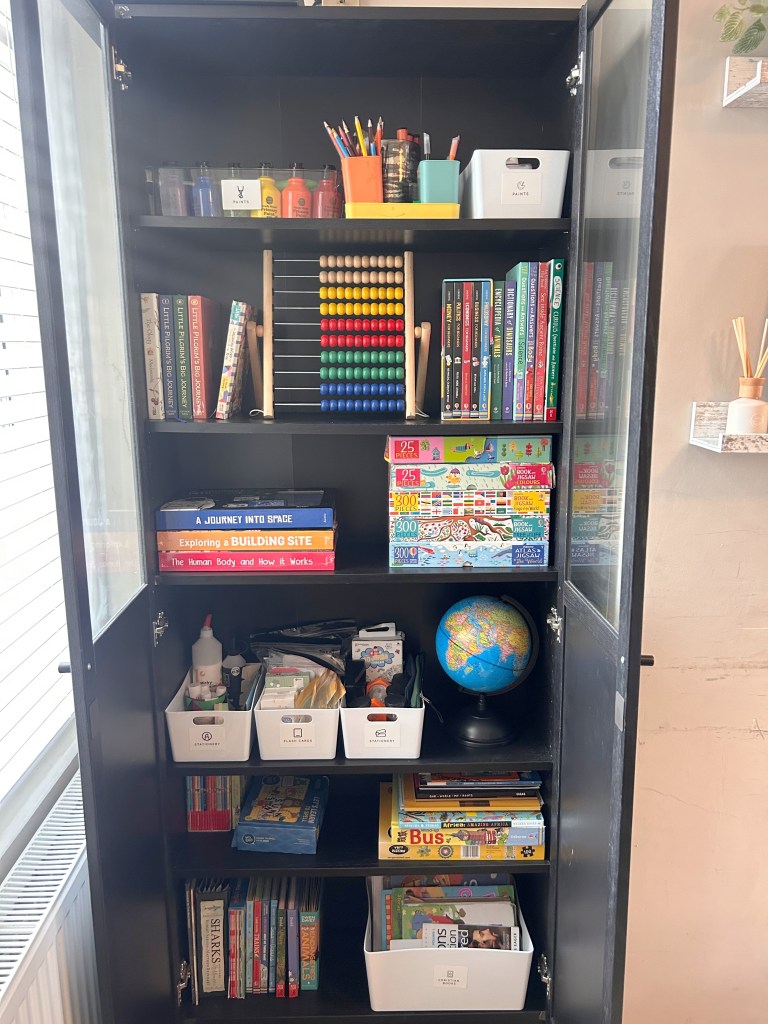
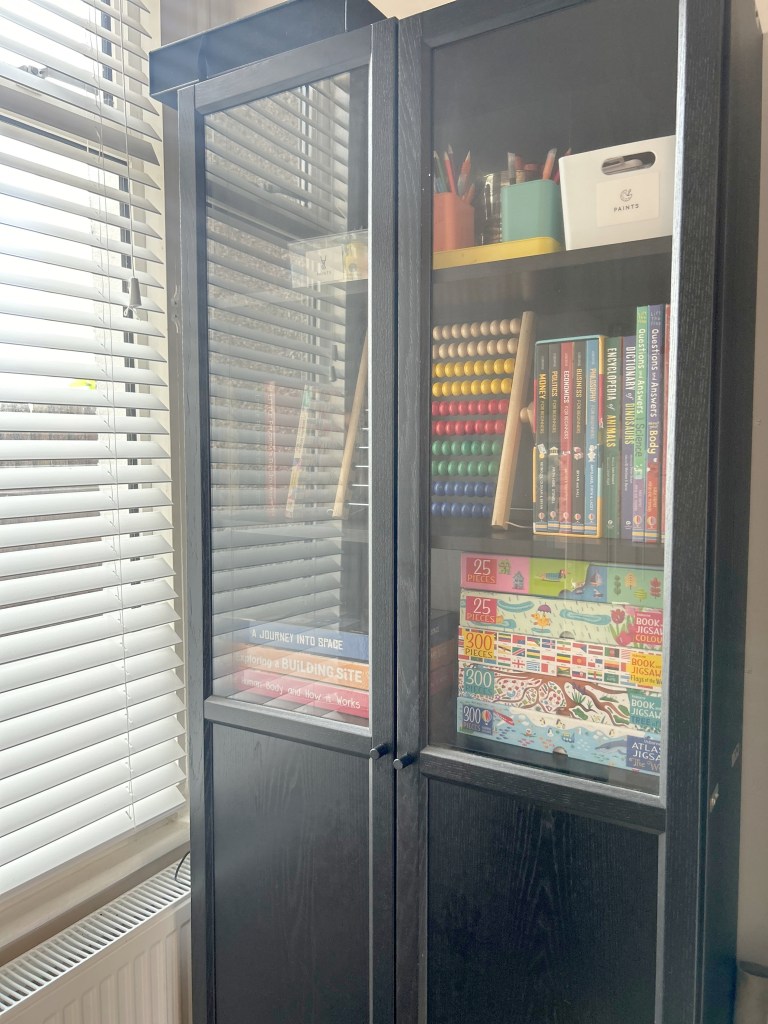
An IKEA Bookcase with panel/glass doors is used to store books and resources that need to be out of reach of young hands, as well as books that are little advanced for them at this stage (but I am still buying or collecting!) We chose the book shelf with panels/doors to create a visually appealing area that is attractive to the eye.
3. Incorporate storage bins and containers
Storage bins and containers are lifesavers for organising homeschool books because they provide a practical and efficient way to keep materials orderly and accessible. With homeschooling often involving numerous books, workbooks, and supplies, these bins and containers help categorise and store items neatly, preventing clutter and making it easier to find specific resources quickly.
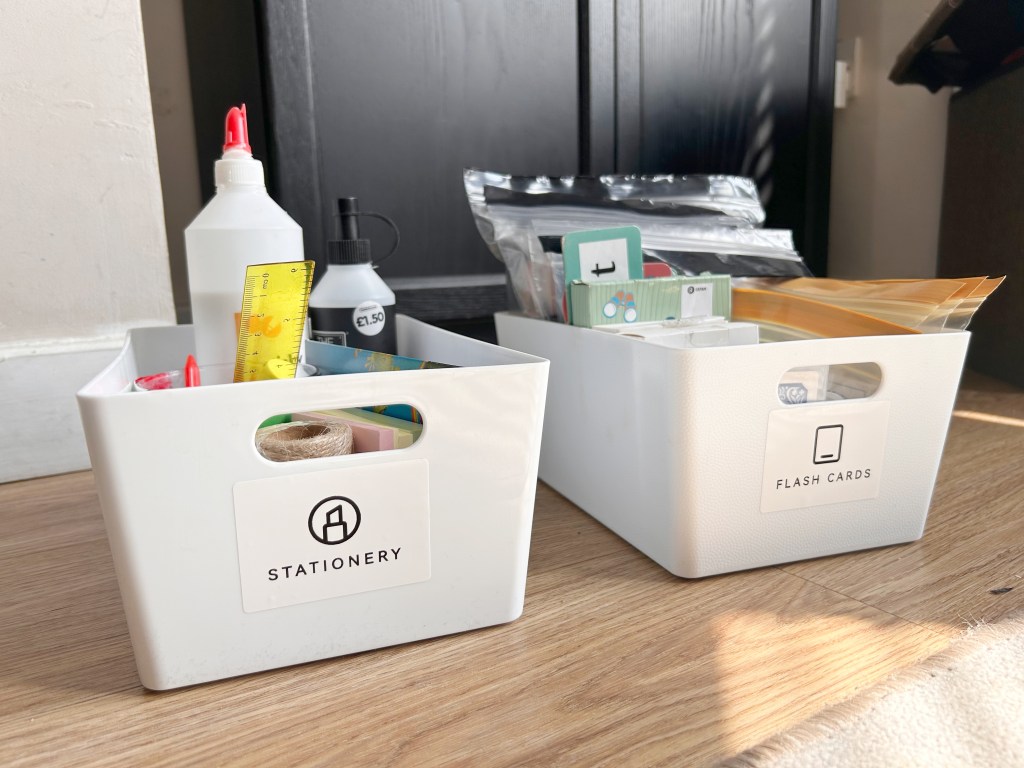
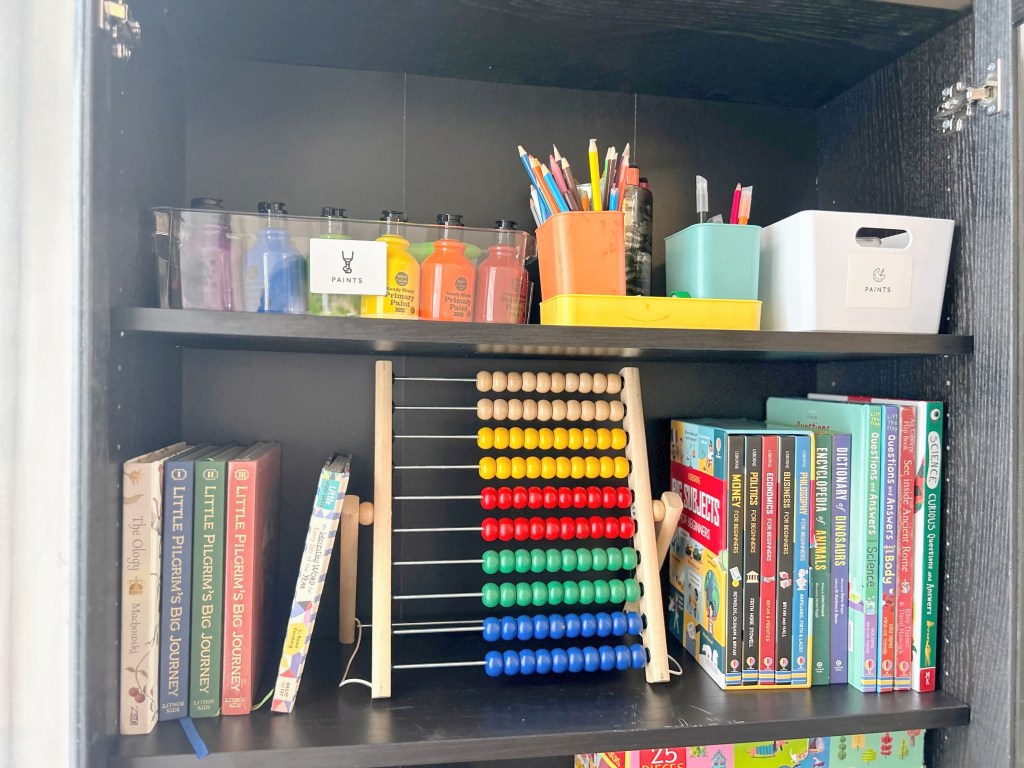
They can be labelled and colour-coded, further enhancing the organisation and allowing for easy rotation of subjects or materials. Additionally, using storage solutions helps maintain a tidy learning environment, which can reduce distractions and create a more focused, productive space for both teaching and learning. This organisation not only streamlines the homeschooling process (allowing you to see exactly the things that you have) but it also instills good habits of tidiness and responsibility in our children.
Use clear bins to store art supplies, science kits, math manipulatives, and other materials. Label each bin clearly to make it easy for your children to find what they need and to put things back in their proper place.
4. Implement a rotating system for supplies
To prevent clutter and ensure that all of your materials are used, implement a rotating system. It’s so helpful especially when we often tempted to add more when we are out and about in the shops. Creating a rotation system can help keep things fresh for us too. Store out-of-season or future materials in a closet or storage area, and bring them out when needed. This keeps your main homeschooling space tidy and focused.
5. Utilise a rolling cart
A rolling cart can be a versatile addition to your homeschool setup and I know a few homeschool mamas who use them. We use a tower drawer unit as I found it more handy to throw toys into when they weren’t in use. Also, I feels easier to keep things neater. You can use either to keep daily essentials like current textbooks, planners, and supplies handy. At the end of the day, It can be rolled away, or picked up and moved to keep your space clutter-free. They are both great options for moving materials from room to room if you don’t have a dedicated homeschool space.
6. Set up a command center
A command center helps to encourage proactivity and focus on daily activities. Using a bulletin board or wall organiser to display your family’s daily schedule, calendar, chore charts, and important notices is crucial for maintaining order and clarity in your household and homeschooling experience.
As busy parents, having a visible, centralised spot for all essential information helps everyone stay on the same page and creates a sense of responsibility and routine among everyone. It ensures that daily activities, appointments, and chores are clearly communicated, reducing the likelihood of missed tasks or misunderstandings. We use yearly calendars, as well as a large whiteboard in the kitchen to help us bring together the many moving parts in our home.
This visual organisation tool can also serve as a motivational center, where achievements and important reminders are highlighted, promoting a positive and proactive household environment. By keeping everything in plain sight, a bulletin board or wall organiser simplifies the juggling act of family life, making it easier to manage time, responsibilities, and expectations effectively.
7. Establish a filing system
Creating a filing system for important papers, assignments, and records is key! You could use a filing cabinet or portable file box to organise by subject or student. This system will make it easier to keep track of completed work and necessary documents as your children grow older.
Organising your homeschool and your home doesn’t have to be a daunting task. With a bit of planning and creativity, you can create a learning environment that is both functional and inspiring. Remember, the goal is to make your space work for youand your children, fostering a love for learning and making homeschooling a joyful experience for everyone involved.
Happy organising and a massive thank you to a dear friend of mine Karla from Klear My Space who helped me sort through and organise my boys things. She’s a wonderful, a reliable and professional home decluttering and organising solutions person who is just a phone call away if you need some help!
Thank you for joining me on this journey of motherhood and faith. If you found comfort and encouragement in this post, I invite you to explore more of my writings on similar topics.
On my blog, you’ll discover a wealth of stories, tips, and reflections aimed at nurturing your spirit and supporting you through the beautiful chaos of motherhood.
From practical advice on balancing daily responsibilities to heartfelt reflections on deepening your relationship with God, there’s something for every season of motherhood. I’ve shared real-life experiences, lessons learned, and moments of grace that I hope will resonate with you and provide the encouragement you need.
Visit my blog for more posts on creating a peaceful home, finding joy in the little moments, and leaning into God’s strength amidst the challenges. Let’s continue this journey together, growing in faith and love, one step at a time.
As a homeschooling Christian mother blessed with three sons, I have found myself reflecting deeply on the values I wish to instill in my children. In today’s rapidly changing world, where traditional gender roles are being redefined, I believe there is immense importance in teaching my boys the skills needed to work within the home as well as outside. While societal norms may have shifted, the timeless principles of responsibility, service, and stewardship remain invaluable, especially within the context of a Christian household.
From an early age, I have sought to cultivate a nurturing environment where my sons not only understand the importance of contributing to the household but also embrace it as a privilege and a responsibility. Contrary to outdated stereotypes, teaching boys to work in the home is not about limiting their potential or confining them to traditional gender roles. Instead, it is about empowering them with essential life skills that will serve them well in all aspects of their lives as they grow older.
Servanthood
Our desire, first and foremost is that our boys know the Lord and walk in His ways Lord willing. I hope and pray that they will take on the role as spiritual leaders of their homes, willing to take on difficult tasks and to face problems with heart until they come to a solution. This takes on the form of servanthood. As Christians, we are called to emulate the example set by Jesus Christ, who demonstrated humility and service through his actions. By involving my boys in household chores such as cooking, cleaning, and laundry, I am not only teaching them practical skills but also instilling in them a spirit of humility and selflessness. These seemingly mundane tasks become opportunities for them to practice love in action and to serve others with joy.
I have to remind myself that this is the training ground. So even if an activity takes much longer, or I receive resistance because they would much rather do something else, I have to gently persevere, encourage and normalise hard work because it is good work!
Accountability
Teaching my boys to work in the home creates a sense of responsibility and accountability. In a world that often prioritises individualism and self-gratification, it is a desire for me to instill a strong work ethic and a sense of duty towards their family and community. By assigning age-appropriate tasks and holding them accountable for their contributions, I am equipping my sons with the tools they need to become responsible and dependable men.
Moreover, teaching my boys to work in our home promotes a culture of teamwork and cooperation within the family. As siblings, my sons learn to collaborate and support each other in completing household chores, creating a sense of unity. These shared experiences not only strengthen their bond as brothers but also prepare them to navigate the complexities of relationships outside the home. They often hold each other accountable when the one is not pulling their weight!
Stewardship
In addition to the practical benefits, training my boys to work in the home also aligns with biblical principles of stewardship. As stewards of God’s creation, we are called to responsibly manage the resources entrusted to us, including our time, talents, and material possessions. By teaching my sons to care for their home and belongings, I am reminding them of stewardship and appreciation for the blessings they have been given.
Here are some fun creative ways for you to encourage responsibility for your children!
Chore Chart: A weekly chart where children can track their daily chores and mark them off when completed.
Responsibility Checklist: A checklist of daily responsibilities tailored to different age groups.
Behaviour Tracker: A printable to help track positive behaviors and areas that need improvement.
Allowance Tracker: A tool for tracking chores completed and allowance earned, helping children understand the value of money.
Goal Setting Worksheet: A sheet where children can set short-term and long-term goals and track their progress.
Time Management Planner: A daily or weekly planner designed for children to organise their tasks and activities.
Reading Log: A log for tracking books read, along with space for notes or reflections on each book.
Family Rules Agreement: A printable contract where the family can agree on certain rules and responsibilities.
Responsibility Badge System: Printable badges or certificates that children can earn when they demonstrate responsibility.
Problem-Solving Worksheet: A worksheet that guides children through the steps of identifying problems, considering solutions, and taking action.
These printables can be designed to be visually appealing and easy to use!
Thank you for joining me on this journey of motherhood and faith. If you found comfort and encouragement in this post, I invite you to explore more of my writings on similar topics.
On my blog, you’ll discover a wealth of stories, tips, and reflections aimed at nurturing your spirit and supporting you through the beautiful chaos of motherhood.
From practical advice on balancing daily responsibilities to heartfelt reflections on deepening your relationship with God, there’s something for every season of motherhood. I’ve shared real-life experiences, lessons learned, and moments of grace that I hope will resonate with you and provide the encouragement you need.
Visit my blog for more posts on creating a peaceful home, finding joy in the little moments, and leaning into God’s strength amidst the challenges. Let’s continue this journey together, growing in faith and love, one step at a time.













 gracedforhome.com