Will i find fulfillment in motherhood?

Today as I struggled to get all boys to bed for the night I thought to myself, wow – motherhood is a beautiful and transformative journey, and it is also one of the most challenging sacrificial roles I have ever known. The endless nappies, sleepless nights, mental gymnastics, and constant demands often leaves me feeling not only exhausted and depleted, but questioning whether this is the place where joy can truly be found.

In the midst of the chaos, there is a deep fulfillment to be found—a fulfillment that goes beyond the immediate, and touches on the eternal. As Christian mothers, we are called not only to care for our children but to see the sacred in the everyday moments and train them up in the ways of the Lord, even when it feels really really hard (and most days, it does). I believe that God created and uses the role of mother to not only refine and transform us into the best version of ourselves, but to help us see His nature and character as we fall short daily.

It’s in those very moments of weakness—when patience runs thin, when exhaustion settles heavy—that God’s grace meets us most profoundly. Motherhood, in all its labour and sacrifices, becomes a living testimony of His strength made perfect in our weakness. The fulfillment we find is not in our perfection, but in the daily surrender, in knowing that our small acts of love and intentionality ripple through their lives into eternity.

Rocking a baby to sleep, correcting with gentleness (or firmness for the 10th time), or offering a whispered prayer over a child’s future are not insignificant; they are kingdom work. Fulfillment comes when we begin to see that this calling is less about what we accomplish in our own strength and more about how Christ shines through us as we do our best to lean wholly on Him.

What does fulfillment mean practically?

Practically, this means first learning to accept that we will not do it all perfectly. There will be days when the house is messy, the laundry undone, or tempers are tested and we are overstimulated more than we can bear. Accepting our human limitations frees us from the crushing weight of comparison and high expectations, and allows us to lean on God’s strength rather than our own.

Alongside acceptance, we can also be intentional about building rhythms into our days that anchor us in God’s presence—whether that’s beginning the morning with a short prayer before the children wake, listening to Scripture as we fold clothes, or finding small pockets of quiet to breathe and remember whose we are. Fulfillment often grows not from grand, sweeping gestures, but from the faithful repetition of ordinary acts offered to the Lord.

We can also build community into our journey, surrounding ourselves with other mothers who encourage, pray, and walk alongside us. In doing so, we are reminded that we are not alone in this calling, and that together we can point one another back to Christ when the days feel long and tiring.

Motherhood is sanctifying. The hard days do not mean failure; they are opportunities for God to grow patience, humility, and love within us. “Consider it pure joy, my brothers and sisters, whenever you face trials of many kinds, because you know that the testing of your faith produces perseverance.” (James 1:2–3)

Will I be as fulfilled in motherhood? I miss my independence.

I think it’s natural for us to wrestle with the fear of “losing ourselves” in the midst of motherhood. For many, the world measures success by productivity, financial achievement, and visible recognition, and stepping into the unseen work of raising children can feel like stepping away from seen purpose. I remember processing the shock of my time no longer being my own when I had my first son, and feeling like my life was suddenly sucked into a vacuum. As much as I felt overwhelming joy and purpose in this new role, I deeply grieved the freedom and independence that I once felt, because all of a sudden, my life was under a spot light- being constantly watched by a little person!

Yet, Scripture gently reminds us that our worth is not rooted in what we do or what we earn, but in who we are in Christ. Motherhood may shift how our time and talents are expressed, but it does not erase them. In fact, it can refine and deepen them. The same skills of creativity, leadership, and problem-solving that shine in a career are often exercised in new, hidden ways at home and we can build up the courage and incremental time to explore these areas of our lives.

While the world may not applaud nappy changes, middle-of-the-night prayers, or the wisdom spoken into a child’s heart, heaven sees and honours these acts as holy work. The truth is that God does not ask us to trade fulfillment for sacrifice—He calls us to find a richer kind of fulfillment through sacrifice, one that is eternal rather than fleeting.

At the same time, embracing motherhood does not mean abandoning every dream, ambition, or calling outside the home. For some, “their own thing” might be pursued alongside motherhood in a different season or at a different pace, and that is okay. God is not wasteful; the gifts He has placed in you are not meant to be buried, but stewarded in His timing.

What motherhood does invite is a reordering of priorities—placing eternal impact above temporary accolades. It means asking not only, “What makes me feel successful?” but also, “What fruit will last beyond me?”

In this light, I am learning to see that motherhood is not the end of identity or purpose, but the widening of it. It is stepping into a calling where unseen work shapes eternal souls, and where success is measured not by titles or paychecks but by faithfulness and love. The world may not always understand or applaud this, but fulfillment in God’s design often looks different from what culture celebrates. It is slower, quieter, and sometimes hidden—but infinitely more enduring.

I hope this encourages you on your journey.

Alethea x

The invisible (yet powerful) economy of homemaking

There’s a quiet economy at work within the walls of a home—one that doesn’t show up on pay slips, spreadsheets, or CV’s. It’s an economy of presence, peace, and provision – one that has taken a long while to settle in my own heart. Coming into marriage and home life from the path of corporate career experience and ambitions , this new path forged by my husband and I was one riddled with insecurity and uncertainty on my part. Accepting that there is also so much worth here, and also means to steward, be creative with and multiply our income breathed new life into my understanding and vision of the home economy.

Homemaking may not always earn an income, but it builds something far richer: stability, trust and belonging. The fruit of it isn’t always immediate, but it is lasting—and far-reaching and in today’s post I want to share a little bit about that.

What is a home economy?

A home economy refers to the way resources—both tangible and intangible—are managed within a household. Traditionally, it’s about how a home operates in terms of stewardship, budgeting, production, and care, all within the unique rhythms and values of a family. It’s not just about money; it’s about the whole ecosystem of a home and how it’s sustained.

A few key elements of a home economy

1. Resource management

This includes managing time, money, energy, food, space, and even emotions of all those that live in your home. Budgeting, meal planning, scheduling, and caregiving are all forms of resource stewardship that keep the household running smoothly.

2. Homemaking as production

While we often think of “production” as something that happens outside the home because it can be measured and scaled, a homemaker also produces meals, routines, clean spaces, emotional support, traditions, and a sense of safety. These things are intangible, and they form the culture and stability of a home.

3. Values-based priorities

Every home has its own “economic system” based on what it values most—peace, hospitality, learning, sports, health, faith, or rest etc. The home economy reflects those values in how time and energy are spent. It’s a slow, often invisible investment in people and purpose.

4. Relational economy

At the heart of the home economy is relationship. Time spent nurturing children, building a marriage, or hosting others isn’t transactional—it’s transformational. It builds emotional wealth and spiritual inheritance that can’t be bought.

So yes, I don’t currently earn a paycheck anymore in the way that I have grown up to know it because in this season, my work is to build up my home economy so that as a family unit we work really well.

There are no deposits with my name on them. No promotions, no raises, no quarterly reviews. No line in our family’s budget that’s “mine,” and for a long time, that quietly haunted me.

While I pour out my days in love and labour — in lunch bags, washing and wiping — a small voice sometimes whispers: “But you’re not contributing. You’re just dependent.”

I used to have my own income. My own purchases. My own ability to say, I’ve got this.

Now, as a full-time homemaker, I offer different gifts: patience, consistency, planning and organising. peacekeeping, cooking, teaching. praying for and with my family, giving big deep hugs, love and smiles to my family. These are not things you can quantify — or add to a bank account.

And that’s exactly what makes this role hard to value in a world that ties worth to a salary.

Sometimes I second-guess even small purchases. I hesitate before I press “buy,” not because I don’t trust my husband’s love, but because something in me wonders if I’ve earned the right to spend. Even in a marriage built on grace, that weight can linger.

And yet, here’s what I’m learning:

I may not bring home a paycheck — but I bring everything else.

I bring a steady presence.
I bring a safe home.
I bring meals, prayers, structure, softness, and sacrifice.

And most importantly, I bring my whole self.

That’s not financial dependence. That’s soul investment.


A Kingdom Perspective

The world sees one income and a woman who has “given it all up”, but God sees a household held together by mutual trust and quiet faithfulness. In James 1:17, we’re reminded:
“Every good and perfect gift is from above, coming down from the Father of lights.”

The income we live on is His. The work I do here — unseen, unpaid — is also His. There is no hierarchy in the Kingdom economy. There is only obedience. And while I may not get paid in pounds, I remind myself often that I’m being paid in something far deeper: Moments. Memories. Heart-shaping. Soul-growing. A front-row seat to childhood, and my life.

So if you’re feeling the ache of not earning…

If you’re wondering if you’re doing “enough” because you’re not bringing in money… Remember: your value is not attached to a paycheck. You are not a burden — you are a builder. You are not dependent — you are entrusted.

God is not asking you to bring income.
He’s asking you to bring faithfulness, trust and your heart each day.

And friend, that’s exactly what you’re doing.

Reframing the perspective for stay at home mums

Choosing motherhood and homemaking is far from a wasted life.

In a world that often equates success with visibility, speed, and accolades, choosing a life of motherhood and homemaking can feel quietly radical.

It’s a path full of unseen moments—toys everywhere, whispered prayers of desperation, patient corrections, and countless acts of service that rarely make headlines. But what the world overlooks, God treasures. This life—your life—is not small. It is sacred.

This post is an invitation to see your everyday with new eyes. To shift from simply surviving the tasks of home and motherhood to embracing them as part of a deeper calling. You’ll find encouragement to anchor your heart in truth, to find purpose in the small things, and to remember that your role carries eternal weight—even when no one else sees it.

What I feel

“This matters”. It is a constant, inner dialogue between my heart and mind—reminding myself that this path, though often unseen or undervalued, holds deep meaning and purpose.

Culture tells me that a successful life looks a certain way—the way of the majority. Because it has been glamorised, measured, and praised, so anything outside that mold can feel small or insignificant.

But the truth is, shaping a home is no small task. Nurturing children, creating peace in a space, building traditions, and tending to the needs of a family requires wisdom, strength, and a kind of love that doesn’t always receive applause. There are no promotions or performance reviews here—only the quiet, sacred rhythms of service and presence.

Still, there are days when the lies whisper louder than truth. Days when dishes pile up, children cry non stop, don’t listen and fight all day, and the world outside feels like it’s rushing ahead while I move slowly, wearily and deliberately, through another load of laundry. I sometimes wonder, Is this enough? Am I enough? And in those moments, I have to claw my way back to what I know deep down: that the unseen work of love is never wasted.

I’m learning that success isn’t always visible, and won’t always feel instant. Sometimes it looks like a child who feels safe, a marriage strengthened by small acts of kindness, or a home filled with peace and a warm meal rather than “perfect”. These things can’t be measured by certificates of well done or accolades, but they matter—deeply. I may not be building a career by the world’s standards, but I’m building something far more eternal: hearts, values, and a legacy of love.

Being at home is a deeply meaningful calling that I am finding is not just shaping my children, but also changing me.

Here are a few thoughts that I hold onto to encourage myself on this journey. I hope they’ll also help you in reframing your perspective if you are a stay at home mum.

1. Recognise the eternal value of your role

It’s easy to overlook the significance of what you do when so much of it happens behind closed doors and without recognition. But motherhood and homemaking are not just tasks—they are eternal investments. Instead of seeing homemaking as mundane, view it as a God-given calling to shape and nurture your family. Proverbs 31:27 says, “She watches over the affairs of her household and does not eat the bread of idleness.”

Every meal prepared, every gentle and firm correction, every bedtime story and prayer whispered over a sleeping child is a seed planted into a soul. Yes, these quiet, repetitive acts may seem ordinary, and can get tiresome, but in God’s eyes, they are weighty with purpose. We are shaping hearts, anchoring lives, and reflecting His love in the most tangible way. We shouldn’t underestimate the eternal value of our role—it reaches far beyond what the eye can see.

2. Shift from “just a mum” to “A builder of the home”

I heard a good friend of mine refer to herself in this way and it struck me deeply. I thought “wow what a beautiful and thoughtful way to describe your presence and role in your home”.

Maybe you’ve heard it said,—or have said it yourself—with a shrug: “I’m just a mum” ” I stay at home with the kids”. After your journey of pregnancy and childbirth, that phrase just carries a weight of dismissal that doesn’t belong. Motherhood is not a lesser calling; it is a foundational one. How quick we are to forget this.

When we shift our mindset from just a mum to a builder of the home, we begin to see our days differently. We are not merely managing messes—we are laying bricks of stability, love, and faith. We are crafting the atmosphere our families breathe. A builder is intentional, strong, and purpose-driven—and that is exactly what you are. You’re not filling time; you’re forming lives.

The world may minimise homemaking, or trivialise it, but Scripture elevates it. Titus 2:4-5 encourages women to love their families and care for their homes. Instead of saying, “I’m just a stay-at-home mum,” say, “I am building a home filled with love, faith, and peace.” Our work is foundational to a thriving household.

3. Find purpose in the small things

So much of homemaking and motherhood is made up of the small things—folding socks, wiping counters, answering endless questions, preparing yet another meal. It can feel unnoticed, repetitive, and, at times, insignificant. I’ve had days when I felt like I would explode with the overwhelm, yet it’s in these very moments that purpose quietly blooms. I know that God doesn’t just measure worth by grand gestures or public applause; He sees faithfulness in the hidden places, and I have to remind myself that when I choose to serve with love in the mundane, I am living out a holy calling. The small things—done with a willing heart—are not small to Him. They are sacred building blocks of a life poured out in love.

When the days feel heavy or unnoticed, pause and whisper a short prayer over what you’re doing—“Lord, let this simple act be an offering of love.” It helps shift your focus from the task to the purpose behind it. Even a folded towel can become holy ground when done with intention and grace.

4. Prioritise personal & spiritual growth

In the busyness of serving everyone else, it’s easy to forget that your soul needs tending too. But personal and spiritual growth aren’t luxuries—they’re lifelines. This is one of the areas that I struggle in often due to sheer exhaustion and lack of motivation at times.

Yet when we pour out daily for our families, we also need space to be poured into- well. Growing in your faith, learning new things, or simply taking quiet moments to reflect are not selfish acts—they’re wise and necessary. A nourished soul creates a nourished home. The more rooted you are in truth, the more grace, patience, and love you’ll have to give. You can’t pour from an empty cup, and God never asks us to run dry.

I start my day—even if it’s just five minutes—with a verse, a journal, or a whispered prayer before the house wakes. It doesn’t have to be long or perfect. What matters is the consistency of showing up and making space for your heart to breathe.

5. See homemaking as a ministry

It can take time to view our homes as a place of hospitality, love, and discipleship. I used to believe that anything worth doing had to be seen and felt by the masses, however ministry doesn’t only happen on stages or in mission fields; it happens right here—in our kitchens, gardens, and bedtime routines. When you begin to see your home as holy ground, the ordinary transforms into something sacred. Your faith is lived out in real time, shaping hearts in the most personal and lasting way.

We are the first example of Christ our families see day in and day out. Our kindness teaches grace, our patience teaches peace, and our sacrifice teaches love over time. Though this kind of ministry may not be noticeable immediately, its impact reaches far into eternity. It’s important to train our minds to start viewing our daily work through the lens of worship. Whisper this simple reminder to yourself: “This is not just work—it’s worship. This is not just a house—it’s a haven.” When we frame our homemaking as service to God, even the smallest acts take on eternal significance.

6. Embrace the season you’re in

Ecclesiastes 3:1 tells us, “There is a time for everything, and a season for every activity under the heavens.” It’s a verse I think about often because it helps to center me in the truth that nothing truly lasts forever. Motherhood and homemaking may feel all-consuming now, but this season is temporary. Every season of life brings its own rhythm—some fast and full, others slow and stretching. It’s easy to look ahead and long for the next stage, or to look back and grieve what’s passed (guilty). Yet there is beauty and purpose right where we are.

God doesn’t waste seasons.

Whether you’re in the thick of newborn days, navigating school years, or adjusting to a quieter home, there is something He wants to teach you here. Embracing the season you’re in doesn’t mean it’s easy—it means we are willing to see it as meaningful, even in the mess, the mundane, or the mystery.

When we stop resisting the present and start receiving it, peace begins to grow. It frees us from comparison and expectation and allows us to truly live the moments we’ve been given. This season—whatever it looks like—is part of your story, part of your shaping, and part of the legacy you’re building.

Here’s a tip for you: write down three things each day that are unique to this season and thank God for them. Gratitude softens the edges and helps our hearts settle into the now.

Final thoughts

To the women quietly walking this road—those who have chosen to pour their lives into homes, children, and the unseen corners of daily life—know this: your work matters. It is not small. It is not second-rate. You are part of something sacred, something that will echo through generations. When the world questions your worth, hold fast to the truth: choosing love, presence, and faithfulness is never a wasted life. In fact, it may be the most meaningful work of all.

How to find value being at home

I remember the day I had THAT conversation with my boss, and handed in my resignation. I had a reliable job, a predictable rhythm, a reason to dress up, show up, and get things done. There was clarity in that world — performance reviews, deadlines, emails, rewards, outcomes. Yet I knew God was calling me out of it. Not because the work wasn’t good, but because from the moment I gave birth to my first son, I could sense Him whispering something deeper in my heart: Come home.

So with questions, fears, uncertainty and courage I said OK.

In many ways, it was beautiful. Slower mornings. More time with my babies. The chance to build something sacred behind the scenes.

But it wasn’t all soft lighting and a peaceful, pristine looking home.

What I didn’t expect was the quiet ache — the questioning of my worth, the mental weight of the mundane and of caring for all the people in my home, the way my world seemed to shrink even as my responsibilities multiplied. I left one kind of work and entered another — one that was far less recognised, but no less demanding.

I struggled to understand how valuable I could be, and yet, again and again, the Lord kept on reminding me: This work matters.

If you’re reading this as a mother who’s come home full time — or is thinking about it — and you’re struggling to feel the value in what you now do day after day, I want to gently offer this space and my thoughts. Not a formula or a fix, but a re-framing. A way to see our role not through the lens of the world, but through the eyes of a God who honours faithfulness in the hidden places.

This is for the mothers, the homemakers, the soul-weary women wondering if they’re doing enough.

I’ll be sharing some honest thoughts about why it feels hard to find value at home, and talk about how to find value here — not just in spite of the hiddenness, but because of it.


Cultural expectations & feminism’s influence

For much of modern history, staying home with your children was the norm. But in recent decades, the cultural message has shifted: women are told that success means being independent, career-driven, self-actualised, and visible in the public sphere. While there’s a lot of beauty in the opportunities now available to us as women, it can also create confusion and guilt when we recognise that are hearts are naturally tethered to home and yet we feel as though by saying yes to home, we are “wasting our potential” or “playing small.”

Many waves of feminism brought important progress: voting rights, workplace protections, and educational opportunities. But along the way, the narrative subtly shifted to suggest that “real empowerment” looks like career success, financial independence, and freedom from traditional roles. In that framework, choosing to stay home — to embrace motherhood as your main vocation — can be seen as backwards, even disempowering. It’s hard to feel proud of something the culture says we should have outgrown.

I am not sure if you’ve felt it, but I have felt the unspoken expectation that women should be mothers and entrepreneurs, and influencers, and side-hustling creatives. Being “just a mum” or “just at home” feels too quiet — too hidden — to count. But that’s a cultural lie, not God’s truth. Faithful homemaking might not be flashy, but it’s foundational. It builds souls. And the people right in our homes, matter just as much and even more than public applause.

Yet because society puts such weight on measurable outcomes, many of us who choose to be stay at home mums feel the need to justify our time: starting a small business, monetising a hobby, or curating a perfect online presence — just to prove that we’re still contributing. But this pressure can steal the peace and purpose of the home-centered calling, turning rest into hustle.

In Titus 2 and Proverbs 31, we see that home-making, child-raising, and nurturing a household are deeply valued by God. Not because they limit a woman, but because they root her in Kingdom work. It’s not about traditionalism — it’s about truth. God created women with the capacity to conceive, carry, nurture, cultivate, and lead in ways that often flourish in the context of home. That calling is not second-class. It’s sacred.

Do not conform to the pattern of this world, but be transformed by the renewing of your mind. Then you will be able to test and approve what God’s will is—his good, pleasing and perfect will. Romans 12:2


Lack of Recognition & Value

What I didn’t fully understand when coming home, was that homemaking and motherhood involve countless tasks—cooking, cleaning, childcare, emotional support—but these contributions often go unnoticed. Unlike a job with promotions and recognition, being a homemaker doesn’t come with tangible rewards or external validation, making us easily feel as though our work is invisible and undervalued, if we do not find encouragement and conviction within.

As human beings, we long to know that what we do matters. That our labour isn’t just effort, but impact. When society consistently overlooks or minimises homemaking — treating it as “less than,” unpaid, or unambitious — it chips away at the sense of purpose that comes from it. It becomes hard to keep showing up with heart when the world acts like you’ve opted out of something more “valuable.” Especially when we are also dealing with the chaotic and unpredictable nature of raising young children.

Modern society tends to praise what earns money, what’s seen, and what scales, and in turn we do too. But homemaking is slow. It’s deeply relational, cyclical, and intimate. You don’t “finish” homemaking — you return to the same dishes, the same floors, the same emotional needs every day. Pouring, filing, loving, and caring. Without broader cultural affirmation, it’s easy to internalise the lie that this work isn’t “real” work.

More times than I care to admit, I have wondered Am I doing enough? Am I wasting my potential? Would I be more respected if I were doing something else? It’s especially on the days when fatigue is at an all time high, I am over touched, stimulated and extremely short on patience. I realise that taking the time to build a home requires maximum effort and strategy.

In Colossians 3:23, Paul writes: “Whatever you do, work heartily, as for the Lord and not for men.” That includes laundry, nappy changes, making dinner, planning the week ahead. The unseen and the unglamorous. When we lose sight of the fact that homemaking is holy work — offered not just to our families, but to God — we start to believe the world’s narrative instead of God’s.


But here’s the truth:

Homemaking is not small. It’s kingdom work.
It’s soul-tending, heart-shaping, and legacy-building.
It’s building a haven in a chaotic world.
It’s servanthood, often without applause — but always seen by the One who matters most.

And when you feel the sting of being undervalued, remember: even Jesus washed feet. Not for applause, but for love.


Loss of Identity & Independence

Many women struggle with losing a sense of self when they dedicate their lives to their families. Before children, I had a career, hobby, and a clear idea of my creative pursuits. The shift to full-time homemaking felt isolating, especially with a lack of support and a big reduction in my time and energy to pursue creative outlets that would allow me to maintain my personal growth.

Likewise, homemaking can blur your sense of self. Before motherhood or homemaking, my identity was certainly tied to things like a career, personal interests, achievements, and even my name — not just “Mum” or “Babe” or “Where’s my sock?” Suddenly I found that my life had become centered around meeting everyone else’s needs, it can be easy to forget who you are apart from your roles.

Being a homemaker often means surrendering personal time, adult interaction, and even financial independence. You can’t clock out. The truth is that you can’t always make choices for yourself without considering how they affect everyone else. Even simple things — like going to the shop alone — become luxuries. That loss of freedom, if not acknowledged and supported well, can lead to quiet resentment or a sense that your life has been absorbed into everyone else’s.

Society doesn’t celebrate self-giving — it celebrates self-fulfillment and we live in a culture that preaches: Be your own boss. Chase your dreams. Put yourself first. But homemaking often calls you to do the opposite: to put others before yourself, to lay down parts of your life (even temporarily) for the sake of another. That’s radically countercultural — and when the outside world keeps shouting that you’ve “lost yourself,” it can be hard not to wonder if it’s true.

Without margin — emotional, spiritual, or creative — it’s also easy to feel like you’re just surviving, not becoming and thriving. And when you don’t see yourself growing, it can feel like you’re stuck, like who you were is slowly fading without something new rising in its place.


But here’s the truth:

Jesus said, “Whoever loses his life for my sake will find it” (Matthew 10:39). This isn’t about erasing ourselves, but about allowing God to reshape our identity in deeper, eternal ways. While the world tells us to find ourselves by doing more, the Gospel tells a different story: we find our truest self in the laying down, in the unseen faithfulness, in the love that gives.

You have not lost yourself.
You are being formed — in the hidden places, in the daily choices, in the humility of service.
You are becoming more whole, not less — even if it feels like a breaking.
Your identity is not erased by motherhood or homemaking; it is being refined, like gold in the fire.

Your value is not in what you produce or how free you feel — but in who you are, and Whose you are.


Monotony & Mental Load

Homemaking is a loop, not a finish line. You clean the kitchen… only for it to be messy a few minutes later. You fold the laundry… only for more to appear within hours. There’s no final product. No final “ta-da!” moment. It’s a well worn and well lived connected life and the constant repetition can make our work feel invisible — and even pointless at times — even though it’s deeply meaningful.

Also, the mental load of homemaking is relentless. We are the keeper of appointments, groceries, events, clothing sizes, emotional climates, relational tension, snack preferences, and who last took a bath. The planning is a full-time job in itself — and unlike a paid role, there’s no handoff at 5 p.m., no weekend shift rotation. You carry it all, often silently.

I’ve found that it’s also hard to feel creative or alive when I am running on empty. The monotony of routines — breakfast, dishes, naps, dinner, repeat — can numb the soul if there’s no space for rest, worship, or beauty. Without outlets to create, explore, or be poured into, it’s easy to feel like you’re just surviving, not living. That lack of stimulation or personal growth can make the role feel more like duty than delight.


The Truth Beneath the Tiredness

The world may not reward the daily acts of care, but the Kingdom does. In Matthew 6, Jesus reminds us that the Father who sees in secret will reward you. Folding laundry with love, wiping counters with grace, answering the same question a hundred times with patience — these are hidden offerings and in God’s economy, hidden doesn’t mean insignificant.

You are not failing because you’re tired of the monotony.
You are not less holy because you feel overwhelmed.
You are a human carrying sacred work that was never meant to be glamorous — only faithful.

You are building rhythms of safety, love, and consistency for your family. That kind of work is the foundation of flourishing — and though it feels like monotony, it’s actually soul-shaping repetition.

And yes, the mental load is real. But so is the God who offers rest to the weary, and wisdom to those who ask.


Financial Dependence

This is also a tough area for me, because we live in a world that says, “If you’re not contributing financially, you’re not contributing.” It’s subtle, but it’s everywhere — in media, conversations, even internal narratives. When you’re not bringing home an income, it can start to feel like you’re not pulling your weight, even though you are carrying the emotional, physical, and spiritual load of an entire household. When you’re not earning income, spending money — even on small things — can start to feel loaded with guilt or hesitation.

You may second-guess your needs, delay purchases, or feel like you have to justify everything. I have had to become more disciplined in this area which is a good thing, and share honest worries with my husband so that I remember that we are one team.

If you once earned your own income, managed your own schedule, and made financial decisions independently, the shift to relying on someone else — even your loving spouse — can feel like a loss of self. It definitely did for me! I’ve found myself grieving that freedom, even while being very grateful for my current role. Even in the most loving, grace-filled partnerships, money has power. When one person earns and the other doesn’t, there can be subtle dynamics of control, decision-making, or even self-censorship. You might feel like you have “less say” or like your contributions are less tangible — even though they are absolutely vital.


The Truth Beneath the Insecurity

Scripture reminds us in James 1:17 that “Every good and perfect gift is from above.” Your household may be operating on one income, but ultimately, it’s not your spouse who sustains you — it’s God. He is the provider, and He honours the unseen labour of the homemaker just as much as the work of the one earning the paycheck. The Proverbs 31 woman didn’t just bring home income — she brought wisdom, order, nourishment, and strength to her home. That’s kingdom wealth.

You may not sign a paycheck.
But you sign every permission slip, every grocery list, every appointment reminder.
You orchestrate peace, build schedules, soothe hearts, make dinners stretch, and turn houses into homes.

That’s not dependency.
That’s investment.
And it’s legacy work.


Comparison & Social Media Pressure

Social media shows the best 5% of other people’s lives — the spotless kitchens, perfectly dressed and coordinated children, mums who seem to juggle business, baking, Bible study, and beauty sleep without blinking. When I look at my life, it often doesn’t look anything like that. It feels as though I am living in my real 100%: the messes, the meltdowns, the mental fatigue, and this gap creates an ache — not because I am failing, but because I am human.

Homemaking doesn’t often look impressive online. Unless your home is photo-worthy, you have a lot of hired help, or you’re doing a trendy renovation, homemaking work is rarely celebrated on social media. Folding laundry, managing sibling fights, or planning meals on a tight budget aren’t “Instagrammable.” So the slow, sacred faithfulness of your daily work feels again invisible. Forgettable. Less than.

Maybe you see women your age launching businesses, writing books, or speaking at conferences while you’re just trying to get everyone to the breakfast table without tears and spilt milk. I tell you, those mornings can sometimes send me right over the edge and I start to wonder: Am I wasting my life? Should I be doing more? It’s easy to forget that your “more” might not be loud or public — but it is just as meaningful.


The Truth Beneath the Scroll

In Galatians 6:4, Paul says, “Each one should test their own actions. Then they can take pride in themselves alone, without comparing themselves to someone else.”
God didn’t call you to someone else’s life. He called you to this home, these children, this season. Not to impress the world, but to serve Him in secret — where true treasures are stored.

You don’t need to look like her.
You don’t need to do what she’s doing.
You are not behind. You are not less.

If you’re building a home of peace, if you’re shaping hearts with gentleness, if you’re staying faithful in small, unseen ways — you’re doing holy work.

Social media might not clap for you.
But heaven sees.
And heaven applauds.


Spiritual & Societal Misalignment

For Christian women, homemaking can be viewed as a calling, but modern culture often dismisses faith-based perspectives on motherhood and family life. I feel the tension between my biblical values and society’s messaging that a career is the only path to fulfillment. Society says: Be independent. Be ambitious. Be seen. The Gospel whispers: Be faithful. Be humble. Serve in secret.

These two voices aren’t always at war — but they rarely walk hand-in-hand. When you choose homemaking as your calling, you might feel like you’re swimming against the current of modern culture, where success is often measured by visibility, productivity, and external achievement.

Choosing to stay home, serve your family, and live quietly before the Lord is sometimes seen as regressive or even oppressive. The modern narrative says, You deserve more than dirty nappies and dishes. And that message can make even the most joyful homemaker second-guess herself. It’s hard to feel empowered when your life looks so radically different from the cultural script.

When your life is rooted in spiritual conviction, but the world doesn’t understand or value those convictions, it’s easy to feel isolated. Homemaking, done unto the Lord, is an act of worship. But worship isn’t always recognised. It doesn’t win awards or get likes. That can be disheartening — unless your eyes stay fixed on Jesus.

Sometimes, even Christian spaces elevate platformed ministry over quiet obedience. You might feel less “useful” because you’re not leading a study, writing a book, or starting a business — even though you’re building a home, sowing Scripture into your children, and laying down your life daily. It’s a lie that says only public faithfulness matters.


The Truth Beneath the Tension

You were never meant to fit perfectly here.
Your calling as a homemaker — shaped by the Spirit, anchored in Scripture — will look strange in a culture that chases self-glory.

But that doesn’t make it less sacred.

It makes it set apart.

You’re not behind. You’re not small.
You’re right where God has placed you — and that is holy ground.


Reframing our perspective

Homemaking will rarely get a standing ovation from the outside world.
There are no medals for folding the fiftieth load of laundry, no awards for whispering peace into a toddler’s tantrum, no public applause for creating a home where hearts can exhale.

But there is a quiet glory here.

A sacredness in the slow.
A strength in the unseen.
A worship woven into the wiping, the washing, the welcoming.

When we reframe our perspective, we begin to see homemaking not as a lesser path, but as a deeply formational one — shaping souls, stewarding peace, and partnering with God in the hidden rhythms of redemption.

We are not “just” at home.
We are curating spaces where people are known, nourished, and nurtured.
We are writing legacy in the ordinary.

And maybe the world will never quite understand.
But heaven does.

God sees every quiet sacrifice, every faithful choice, every moment when you lay down your life in love — and He calls it beautiful.

So let’s lift our eyes.
Let’s reframe the work.
Let’s remember that this, too, is Kingdom ground.

You are not less because you are at home.
You are planted here — with purpose.

And that, dear friend, is a holy calling.

How to nurture a boys heart

Nurturing my boys’ hearts is one of the most important parts of my role as their mother. As a homeschooling mum of three boys, my husband and I have the privilege of being with them daily, shaping their character and guiding them toward Christ and into being strong boys and eventually men.

Homeschooling gives us a beautiful window of time and influence to not only teach academics, but to shepherd the hearts of our sons with intention. I always remind myself that It’s not just about teaching maths and reading—it’s about helping them develop a heart that seeks after God, is resilient, loves others well, and stands firm in the Christian faith. In a world that will constantly try to define them by achievements and success, I want them to know that their true worth is found in being sons of the true King.

Seeing their hearts

When we started our homeschool journey I was so geared toward only building them up academically, but I very quickly realised that in order to build a meaningful learning experience for them, I would need to win their hearts over with love, friendship and trust. Building a relationship with each boy where I do my best to see them for their individual strengths and personalities would help strengthen their sense of safety and confidence. It isn’t easy, because most of our days are quite loud and feel chaotic, and so the last thing I want to do is notice and compliment all the great and fun things about them (just being honest!) It’s a discipline that I am working on being more intentional in.

It’s also really easy to focus on correcting behaviour all the time, but true growth happens when we understand the heart behind it. When a boy is acting out or withdrawing, it’s often a signal of something deeper—confusion, frustration, or even a need for connection. Being intentional in this area for me means, trying my best to remember to pause, ask questions, and listen with grace.

“A gentle answer turns away wrath, but a harsh word stirs up anger.” – Proverbs 15:1

Grace-based correction—rooted in relationship—helps a boy know that he’s loved, even when he makes mistakes.

Encouraging emotional honesty and empathy

Many boys are naturally active, physical learners, but they also carry deep emotions—sometimes masked by noise or movement. We’ve had to learn to give our sons language for their feelings. This helps them to communicate in a more self controlled way when they are feeling an emotion.

Creating an atmosphere of love and grace at home is also essential. I want my boys to know that our home is a safe place where they can be vulnerable, share their fears, and ask hard questions. I remind them that no mistake is too big for God’s grace and that nothing they do can separate them from His love—or mine. By showing them unconditional love, I hope to give them a glimpse of the immeasurable love of their Heavenly Father.

Conversations

Intentional conversations are another way I nurture their hearts. Whether it’s around the dinner table, during a car ride, or at bedtime, I try to engage their minds and hearts with meaningful discussions. We talk about faith, courage, kindness, and even the struggles they face, or anything random that may come to mind. I want them to know that their thoughts and feelings matter, and more importantly, that God cares about every detail of their lives.

Life skills

In raising boys, we’re not just preparing them for independence—we’re shaping their character and hearts for the life God is calling them to live. Teaching life skills within the rhythm of home and homeschool life is a sacred opportunity: a chance to model servant leadership, responsibility, and integrity. The boys are involved with learning to cook, tidying the garden and house, caring for each other and discussing life matters. As we teach our sons to work with their hands and think with wisdom, our desire and prayer is that it will help them grow into men who are not only capable but compassionate—anchored in faith, and willing to serve and work hard.

Service

Encouraging them to serve others is another way to shape their hearts for Christ. I remind them that true strength is found in humility and that leadership comes through service. Whether it’s helping a younger sibling, assisting a friend, or participating at church, I want them to experience the joy that comes from putting others before themselves. Jesus was the ultimate servant, and I pray my boys will follow in His footsteps.

Above all, I entrust their hearts to the Lord. I can do my best to teach, guide, and love them, but ultimately, their walk with God is their own. My prayer is that they will grow into men who love Jesus deeply, stand firm in truth, and live with integrity. Proverbs 3:5-6 says, “Trust in the Lord with all your heart and lean not on your own understanding; in all your ways submit to him, and he will make your paths straight.” That is my hope and prayer for my boys—that as they journey through life, their hearts will grow to be steadfast in Christ.

Dealing with monotony and routine as a stay at home mum

Being a stay-at-home mum is a beautiful calling, but it often comes with the challenge of monotony. The endless cycle of laundry, cooking, cleaning, and always being switched on to care for our children can sometimes feel repetitive and even overwhelming. It’s easy to lose sight of the bigger picture when daily tasks seem to blur into one another. However, as Christian mothers, we are reminded that even in the most mundane moments, God is at work in our lives and in the lives of our families. If we truly look, we’ll find Him.

One of the most encouraging truths in Scripture is found in Colossians 3:23: “Whatever you do, work at it with all your heart, as working for the Lord, not for human masters.” This verse reminds us that our work at home is not insignificant. Every nappy changed, every meal prepared, and every book read is an opportunity to serve God and our families with love and dedication. When we shift our perspective to see our daily tasks as acts of worship and privilege, we can find deeper meaning in what might otherwise seem mundane.

Gratitude helps

One way to combat the monotony of routine is to cultivate a heart of gratitude. Philippians 4:6 encourages us to bring everything to God with thanksgiving. Taking a moment each day to thank Him for the little blessings—our children’s laughter, the comfort of our home, the provision of food, hot water, clothes—can really transform our outlook. Gratitude refocuses our hearts on the goodness of God rather than the repetitiveness of our routines, and it helps us to see abundance rather than lack.

Spiritual renewal

As mothers, we pour so much into our families, but we must also allow ourselves to be filled. I’ll hold my hand up and be the first to admit that sometimes sheer exhaustion makes me demotivated to pour into myself spiritually, but spending some time in prayer, reading scripture, or even listening to worship music while doing household chores does nourish our souls and keep us connected to God. When we prioritise our relationship with Him, we are better equipped to handle the demands of daily life with patience, wisdom and joy.

Building and nurturing friendships

Finding community is another key aspect of overcoming monotony. Proverbs 27:17 says, “As iron sharpens iron, so one person sharpens another.” Whether through church groups, Bible studies, or simply connecting with other mothers, having a support system helps us navigate the challenges of motherhood. Sharing experiences, praying together, and encouraging one another can breathe new life into our routines. I’ve personally found that taking some time to speak with and laugh with friends helps me to reconnect with a different part of myself, which in turn helps me to feel refreshed.

Monotony and simple living can also be a gift to us. In a world that constantly seeks distraction and busyness, the slower rhythms of homemaking allow us to cultivate a heart of peace and contentment. When we embrace the simplicity of our daily lives, we are able to focus on what truly matters—our relationship with God and the love we share with our families. God often speaks to us in the quiet moments, in the steady rhythms of daily life, reminding us that He is present in every small act of love and service.

How to raise confident and resilient boys

Raising confident and resilient boys in today’s world is challenging, unpredictable, full of constant adjustments, chaotic, downright exhausting, deeply fulfilling, messy and full of lots of teaching moments. As a homeschooling mum to three boys who are still babies to me (6,4 and 2 years) I am slowly learning that raising strong, capable young boys into men has become one of our aims. This isn’t about giving them an ego boost or bubble-wrapping them from failure, but about teaching them how to handle themselves when life’s inevitable bumps occur, and to deal with imperfections and bruises with grace, grit, and from a strong foundation in Christ.

Perseverance

One of the first and constant lessons that we are currently working on, is that failure and imperfection isn’t the enemy. When they get answers wrong, make a mistake or do something imperfectly, their natural response is to shut down, give up or walk away in tears because of the feelings of frustration and disappointment. In our home, my husband and I are consistent in pushing back against this and communicating to them that we celebrate mistakes (sometimes with a little treat) because they are an opportunity for us to learn and grow stronger.

When my first born son struggles with a concept during our learning time, or he colours out of the line during art time, we respond with enthusiasm because we have a chance to try again, and sometimes that is what life gives us- a chance to try again. We encourage him to know that it is ok to feel what he is feeling, but that he should never quit on himself. Resilience isn’t about never falling down; it’s about getting back up, dusting off the sawdust, and trusting that God will guide and strengthen us as we try again.

Confidence, too, is something that we are nurturing. As our boys are very young, we offer this through constant praise the majority of the time because I recognise that our hearts need to know that we are seen by those closest to us, and as their mama, it is my joy to let them know that I see them, love them, celebrate and affirm them.

There are moments when we explain that as they grow, their confidence wont come from constant praise but from real accomplishments and faith in God’s plan. So we do occasionally let them struggle and push through math problems, writing that tricky word for what feels like the hundredth time, and learning how to work together to serve one another during meal times (putting cutlery out, and setting the table). When they achieve something after working for it, the confidence sticks because they know they earned it through perseverance and God’s strength.

Service unto each other and strangers

My boys are very visual, and I quickly learnt that in order to capture their attention and imagination, it would be very helpful to give them a vision of the kind of boy and man that God is helping them to become day by day.

We usually say something along the lines of:

“God has created you for a purpose, and no challenge is too big when you walk in His strength. Keep trusting Him, keep learning, and keep growing into the man He is shaping you to be.

“You are a warrior for Christ, and true strength comes from faith, kindness, and perseverance. No matter what happens, remember that God is always with you, guiding your steps.”

“When you do hard things, God is helping you grow stronger and stronger”.

We are all naturally self centered, and children demonstrate that to the highest degree because they are children(!), have constant legitimate needs and are under developed in their understanding, maturity and expression of their needs.

Another one of the areas that I am working on when it comes to raising resilient sons is teaching them to serve each other and other people. Serving each other doesn’t always feel pleasant because they bicker, fight and compete against one another, but by learning the discipline of service to one another, they fulfill a really important goal of our family which is to love and work together as one in our home.

When they understand that their strength, and their faculties (hands, feet, eyes, speech) are meant to be used for God’s glory it gives them an external motivation. So gentle reminders are given when we are at home and out in public to help them think outside of themselves and to see the world and people around them—whether that means helping to open the door for someone or comforting a friend who’s has been hurt— it’s all to help them develop a deep, quiet confidence that isn’t rooted in arrogance, but in purpose. Plus, let’s be honest, there’s nothing quite as humbling as helping to clean up after your brother or others! Jesus Himself taught us that true leadership comes through service, and I want my boys to follow His example, and understand the inner strength it takes to think of others.

It’s OK to cry

We are at a stage in life with our boys where crying is the resounding sound in our home, so let’s talk about emotions for a second. We are balancing the importance of them talking with us when they are upset over screaming and shouting. Simultaneously we acknowledge that being strong doesn’t mean stuffing down their feelings and pretending that they are ok when they aren’t.

Boys also need space to express frustration, sadness, and even joy without being told to “be strong.” In our home, we encourage each other to talk things through—sometimes by removing them from a tense environment because resilience isn’t about hiding emotions but trying our best to handle them in a Christ-centered way. Praying together, reading God’s Word, and seeking His wisdom helps us all to process our emotions in a way that strengthens our faith and character.

Role Models

Positive role models also play a crucial role in building resilience. Boys need to see strong, faith-filled men who exemplify integrity, perseverance, and humility. Whether it’s their father, a pastor, a coach, or a trusted mentor, having godly role models shows them what it means to live with strength and grace under pressure. When they see men who turn to God in times of struggle, who admit their mistakes, and who stand firm in their beliefs, they learn to do the same. Surrounding them with wise, godly counsel reinforces the values we teach at home and gives them examples to emulate as they grow. As they are young, we have begun that journey for them through stories and books, as well as spending quality time with daddy.

Series and books that they enjoy are Bibleman, Veggie Tales, Emmanuel’s Dream: The True Story of Emmanuel Ofosu Yeboah, Ten Boys Who Made a Difference (Lightkeepers) and much more.

Proverbs 22:6 reminds us to “train up a child in the way he should go, and when he is old, he will not depart from it.” At the end of the day, our goal isn’t to raise tough guys; it’s to raise kind, courageous, and faithful men who will stand firm in a shaky world. With a lot of prayer, patience, and probably a lot more mistakes, I trust that God will shape them into exactly who He created them to be, and we look forward to celebrating the good fruit that comes from their lives!

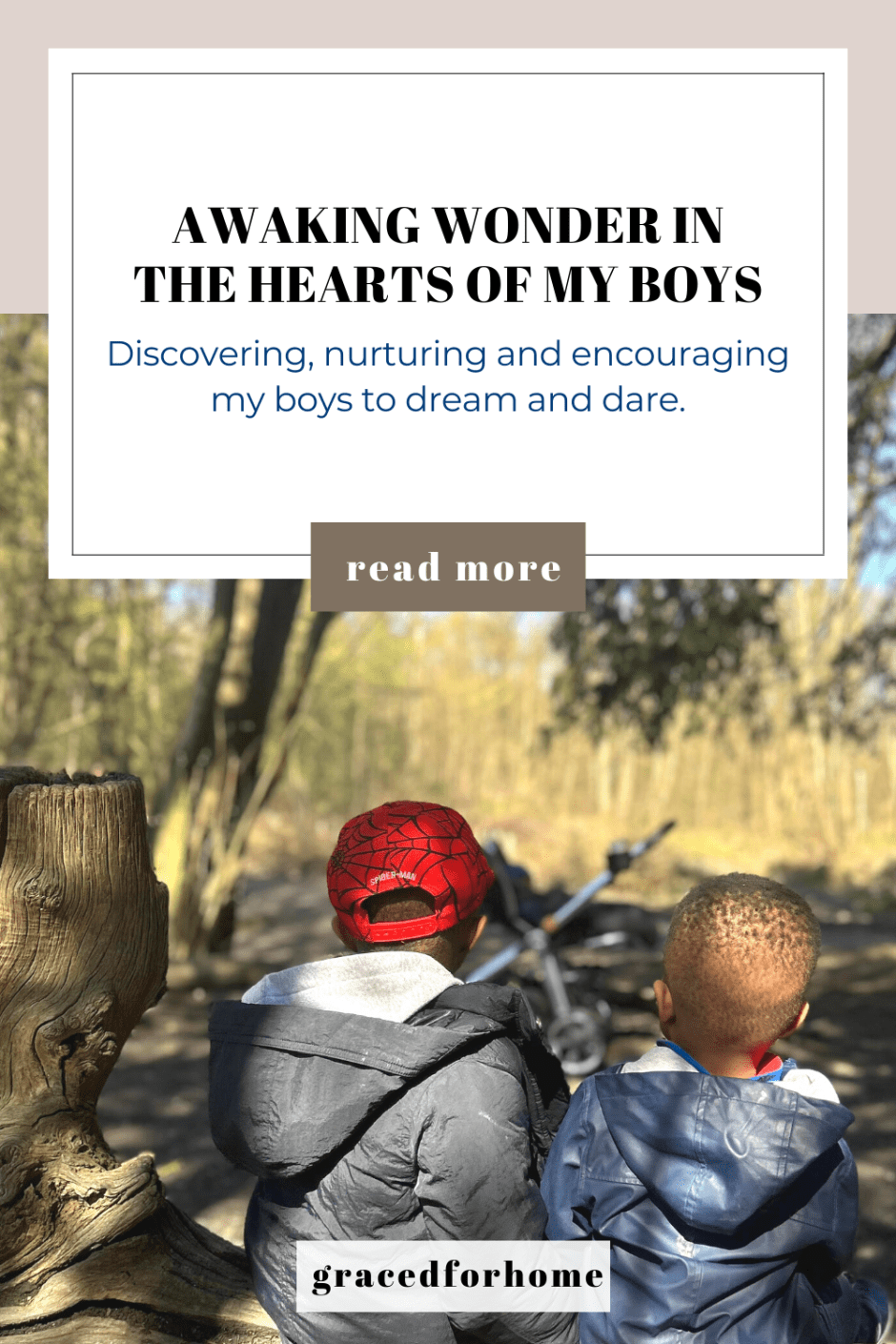
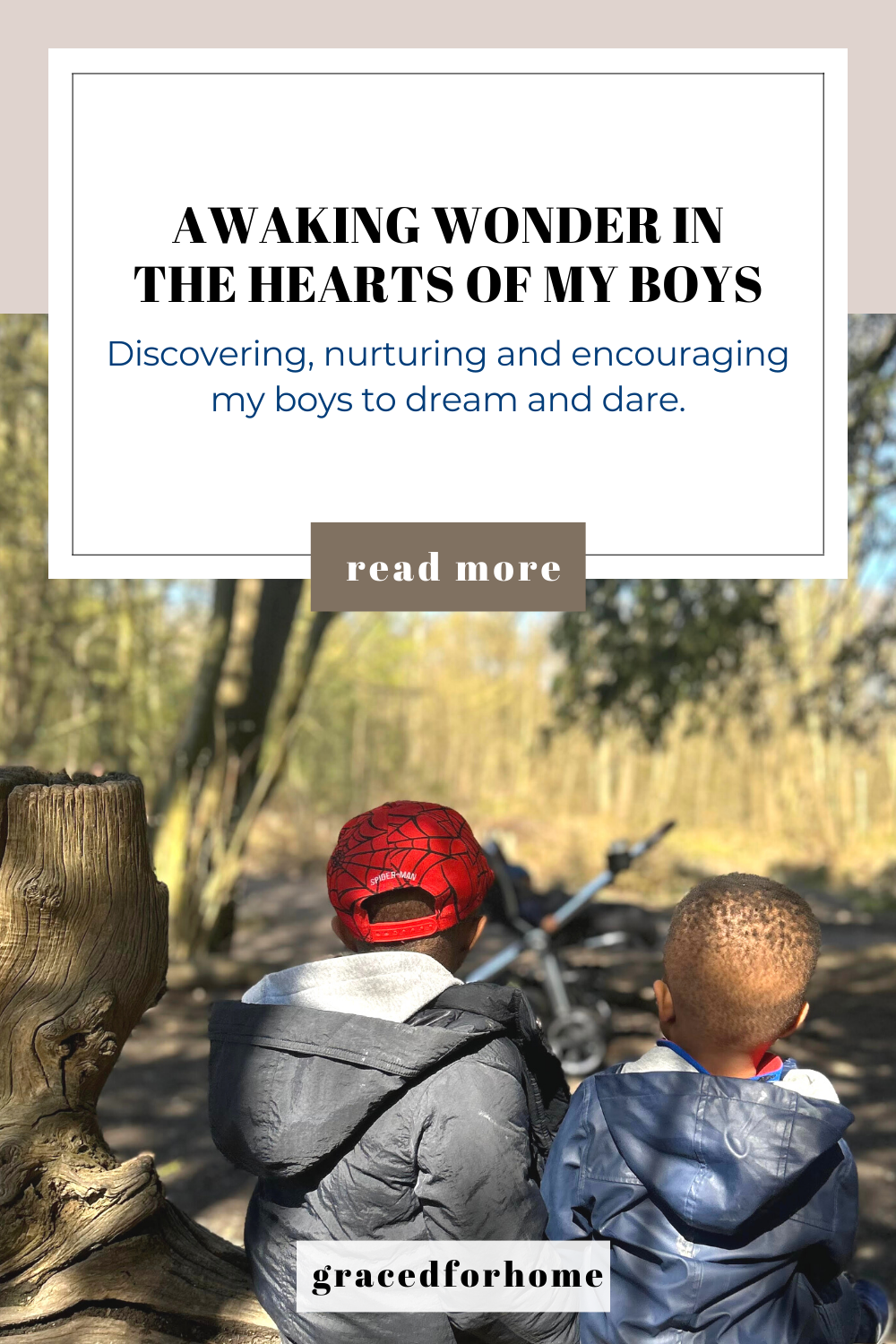
Awaking wonder in the hearts of my boys

My boys by nature are already bent towards wonder. If they aren’t jumping off furniture imagining that they are flying superhero agents sent to rescue the world, they are completely immersed in the land of all things soil, mud and water as they dig to find treasure, or create foundations to build forts, castles and temples!

There is a part of us that has a longing. A deep well within us that needs filing with the fullness of God, but If I am honest, the thought of awaking wonder in the hearts of my boys feels like an intimidating prospect because there is a huge part of me that feels stuck when I consider being this other version of myself who is free spirited and sees and feels all the beauty around me.

It feels hard because I have been trained into a system that values results, efficiency, competitive edge, hurriedness over a slower more savored pace of life. I suppose the title of this blog post should be “how to awaken wonder in my own heart”.

My boys by nature are already bent towards wonder. If they aren’t jumping off furniture imagining that they are flying superhero agents sent to rescue the world, they are completely immersed in the land of all things soil, mud and water as they dig to find treasure, or create foundations to build forts, castles and temples. I honestly look at them most times in amazement. We absolutely have hunters, wrestlers, producers and conquerors in our midst! They are so cool and remind me that we have an innate pull within us to bring forth creativity in our own unique way.

I have to be honest also, that most of the time, I am also thinking “what on earth…” because I just feel so far removed from the way a boys brain is wired to work! Yet God has given me this portion. The three most wonderful boys to nurture, disciple and raise into wonderful men who reflect the image of God.

When I think of awakening wonder in the hearts of these souls, I think about leaving a legacy of hearts that beat after the unseen things of this world, while appreciating the very things that anchor us in real relationship, community and life. I think of hearts that beat strongly and thirst for knowledge in real tangible ways, hearts that feel full and satisfied with the precious simplicities of life that we are so unfamiliar with. Awaking wonder to me is about loving and nurturing each boy individually so that they grow roots in who they are without ever feeling the need to compete with others. To feel wholeheartedly secure in Christ and in your place in this world is probably the most anchoring experience that we can desire.

My view of education is changing and I never ever thought that I would experience this! I see now that it isn’t linear. The path to “success” and fulfillment isn’t just one way that we all have to walk and I need them to know this. There is so much wonder, so much to ponder on, so much to explore and to wrestle with in this rich life and I really want them to have this. Academic success is important, but I believe that a life undergirded by faith and inner character is more of a blessing- brings forth more of a fruitful and full life.

I want them to be free enough in their minds to build a deeply fun life giving enough time for their hearts to taste and see all that life has to offer. Seeking after it. Finding wonder and inspiration that organically and authentically propels them forward to their next learning adventure- because it truly never stops.

God bless,

Alethea

Why Graced for Home?

I, like many women had only one goal in mind as I grew up. Work hard to be competitive in the market place. The best in my field. Get that competitive edge so that I could stand out and land the high paying job with an incredible benefits package. I knew that I wanted to become a mother one day because it was the other natural path that I desired but my entire focus was on career and making money. I was and still am an ambitious, and highly capable and productive woman with several dreams and abilities.

However things started to change for me when I left my first very good corporate job to work part time for my church at that time. I was newly married and I realised that a huge part of me also had a heart for home. I am incredibly passionate about building with my own tribe, having time to intentionally create a life of joy, adventure and success according to what it means to our unique family. I wanted to learn how to be this way.

That’s also when I felt the tension between the two. Seasonally, I came to realise that I couldn’t have the two at the same time. Yet the pull for home became intensely strong when I had my first son. Seeing that new life that my husband and I co created shifted my perspective on life and motherhood entirely.

Choosing to walk confidently in Gods design requires a step of faith- a step away from the marketplace of activities and into the mummy place of the home, which is filled with beauty, love, creativity, purpose and peace”. Sally Clarkson

Yet I also realised that I naturally was entering into motherhood with so much insecurity, fear and confusion regarding my personal role and ability. I wasn’t confident in so many areas, and yet I still had a strong heart to be based from home with my child and now children.

The desire for this blog really is to;

  • Document my personal journey as a Christian woman and mother
  • To document and encourage others on the journey of raising boys
  • I have truly felt afraid to lean into this new version of myself because in alot of ways it confirms the new journey that I am on and I have never considered myself living this- and putting it out there for the world to see. I still coming to terms with a lot of things everyday! Yet I have accepted that this is the most authentic way that I-Alethea can express myself. This is what God has given to me and I am compelled towards it. Especially as I desire to teach my children to keep their hearts open to who God has called them to be and lean into their natural gifts. I have to model this and can’t run away from it.
  • It is making me a better mother.
  • To encourage Christian mothers, and specifically stay at home mothers that we can absolutely do this and grow in confidence managing the home, loving and nurturing our children, and discovering new things within ourselves- our skills etc and still thrive beautifully as individuals. Staying at home does not have to be filled with insecurities.
  • Share my journey of home education and encouraging mothers in this area too, sharing some resources that I make for my children to learn with.

I hope you’ll journey along with me x